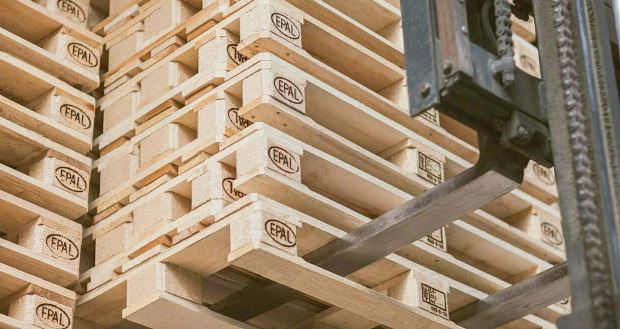
The scarcity of the raw material is pushing up the cost of
a key element for exports and trade of made in Italy
The structural scarcity of raw materials is pushing up the price
of pallets, which is approaching the record highs reached in
2022, despite a market phase of weak industrial demand with
manufacturers unable to pass on increases downstream in their
supply chain.
One of the main reasons for this increase can be found in the
fact that, in order to have the raw material (logs), Austrian
and German sawmills accepted the high price increases demanded
on rebar by forest owners at the beginning of the year. As a
consequence, all downstream sectors, particularly those with
lower added value such as the pallet sector, find themselves
squeezed between the rising prices of semi-finished products
(Austrian and German) and the market's difficulty in recognising
these price increases in the short term. This will not be the
case for a long time, in the event of constant price increases
on rebar/sawlogs. In this context, however, it must be
considered that the pallet and industrial packaging sectors in
Italy are strategic for national and international logistics and
for continuing to export Made in Italy. In fact, these are two
sectors that have continued, according to Fitok data, to
register growth in consumption volumes (+6.20% in 2025 over 2024
and Epal pallet production +3.5% in 2025 over 2024).
The forecast for 2026
According to Conlegno's analysis, the market will remain
volatile until mid-2026, and there is a real risk of a
logistical 'bottleneck': if industrial demand were to suddenly
pick up again, the physical shortage of logs could cause a
supply bottleneck similar to that of 2022. The beginning of the
year 2026 saw further demand for sawn timber prices of 15 to 20
euros per cubic metre, with the structural shortage of roundwood
in Europe not likely to be resolved in the short term. New
long-term strategies are therefore needed. In light of these
considerations, in order to avoid a new acute timber shortage
scenario, similar to 2022, it is essential to strengthen the
cooperation between pallet suppliers and customers and a greater
understanding of the criticality of the situation. Furthermore,
it is necessary to rely on reliable semi-finished product price
indices such as the one compiled by Cril and to put this in the
contracts between pallet and wood packaging supplier and
customer.
The rebar market trend
Austria is in a phase of strong demand and rising prices for
sawmill logs (spruce at around EUR 125/130 per cubic metre),
driven by the limited supply of fresh coniferous timber and low
stocks at sawmills. The wet summer weather has significantly
reduced bark beetle damage, reducing the amount of 'emergency'
timber available. Austria's imports of saw logs in the first
eight months of 2025 decreased by 11%, reaching the lowest level
since 2015. The main suppliers (Germany, Czech Republic, Italy,
Slovenia) all reduced deliveries. Lastly, persistent bad weather
aggravated logistics and transport. Due to the shortage of round
timber, sawmills in Upper Austria are finding it difficult to
fill their warehouses with round timber.
In summary, the availability of wood (which accounts for about
75 per cent of the cost of pallets) has collapsed due to a few
specific factors: depletion of 'cheap wood' (the availability of
infestation wood - bark beetle - which had lowered prices in
previous years has ended); European Log Gap (bad weather in
Austria and Scandinavia has reduced logging); more exports to
the USA where prices are higher due to tariffs against Canada;
and the risk of closure of some European sawmills which, with
these prices, are forced to work at a loss.
The direct impact on prices
The increase in the costs of semi-finished products has been
sudden and is certified by the sector indices: the German Hpe
index has recorded +17% since the beginning of 2025; the Italian
Cril has recorded +12% in just four months. Particularly in
Italy, which imports 80 per cent of its wood, foreign price
increases are reflected on pallet lists in just a few weeks. The
increase in costs was not only affected by the price of wood,
but also by rising energy costs for HT treatment (ISPM-15) and
inflation on steel nails.
Source:
en.ilsole24ore.com


