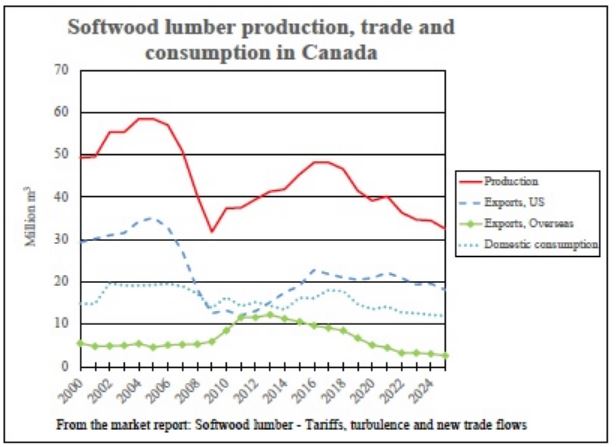
Canada’s lumber industry is heavily export-dependent. Roughly
65% of Canadian lumber production is sold abroad, and the US
remains by far the largest customer, accounting for about 87% of
exports in 2025 (see chart). This reliance leaves Canada highly
exposed to US trade policy.
In 2025, the US imposed new trade barriers on Canadian lumber,
including “Section 232” tariffs and higher Anti-dumping (AD) and
Countervailing Duties (CVD). Combined, these measures increase
Canadian producers’ costs by an estimated 25-30%, significantly
eroding price competitiveness and pushing many sawmills into
negative margins, according to the new market report Softwood
Lumber – Tariffs, Turbulence and New Trade Flows to 2030.
In response, Canada is expected to seek greater market
diversification in regions such as China, Japan, India, Europe,
and the Middle East. However, diversification is challenging.
Canadian lumber is manufactured to North American grades and
sizes, while many overseas markets use different specifications.
Shipping distances are longer, logistics costs are higher, and
building reliable long-term relationships takes time in these
regions.
As of 2025, export volumes to regions beyond the US are near
historic lows (13% of exports in 2025, compared with an average
of ~ 20% over the past 20 years), meaning diversification will
be slow and unlikely to offset reduced US access in the near
term (see chart)
.
Declining log supply is also constraining production,
particularly in British Columbia, which represents a large share
of Canada’s softwood harvest and lumber exports. Over the past
20 years, the province’s allowable annual cut (AAC) has fallen
by one-third due to timberland setasides, Indigenous rights
settlements, insect infestations, and wildfire losses. Harvest
levels have dropped by about half, raising log costs and leaving
many older sawmills uneconomic. This has prompted Canadian firms
to shift investment capital to regions with more abundant and
lowercost timber, particularly the US South.
Because sawmills anchor the broader forest products value chain,
mill closures have cascading impacts. When sawmills shut down,
pulp mills, panel manufacturers, and pellet producers lose
access to residual fiber, which increases their costs and
sometimes forces closures. The resulting contraction affects
employment, rural communities, exports, and GDP.
The Canadian government is responding with financial support and
new procurement initiatives.
Federal measures include loan guarantees to ease liquidity
pressures, funding to encourage product and market innovation,
and “Build Canadian” policies intended to increase domestic wood
use in construction. However, these efforts cannot fully offset
structural disadvantage related to timber supply, high sawlog
costs, and competitiveness in the critical US market, the report
says.
Conclusions
Canada’s lumber and forest sector is expected to continue
contracting through 2030. Sawmill capacity will decline,
particularly among smaller and older operations in regions
affected by insects and fires, and export patterns will slowly
rebalance away from the US. Rural communities will bear the
greatest impacts. If US tariffs are eventually removed, the
surviving modern mills could benefit from improved margins as
lumber prices are likely to increase in the US. Meanwhile,
opportunities exist in gradually growing overseas markets and in
the domestic construction sector, where housing starts would
need to roughly double by 2035 to meet projected demand.
Achieving that, however, would require policy changes,
streamlined permitting, and lower construction costs - none of
which are guaranteed.
Source:
ajot.com


