Industry outlook for 2025-2026 reveals cautious optimism despite
raw materials constraints and shifting demand patterns.
The European softwood industry is navigating a period of
gradual stabilization after three years of difficult market
conditions, according to outlooks presented at the 73rd
International Softwood Conference in Oslo in October 2025. While
both producers and traders report modest improvements, the
sector faces continuing challenges, including record-high log
prices, limited spruce availability, and subdued construction
activity across key markets.
Production stabilizes at reduced levels
European sawmill production has plateaued at approximately 78
million cubic meters per year across European Organisation of
the Sawmill Industry (EOS) member countries since 2023,
representing a 10% decline from the 2021 peak of 86 million
cubic meters, according to EOS President Tommi Sneck. When
including all EU countries plus Norway and Switzerland, total
production reaches 97 million cubic meters.
“After peaking in 2021, production in the EOS countries declined
significantly over the last few years to adjust to the demand
decline,” Sneck told conference attendees. “Since 2023, in the
EOS countries overall, production is stable at around 78 million
cubic meters on levels lower than the period before the
pandemic.”
Country-level data reveals varied performance across Europe’s
major producing nations:
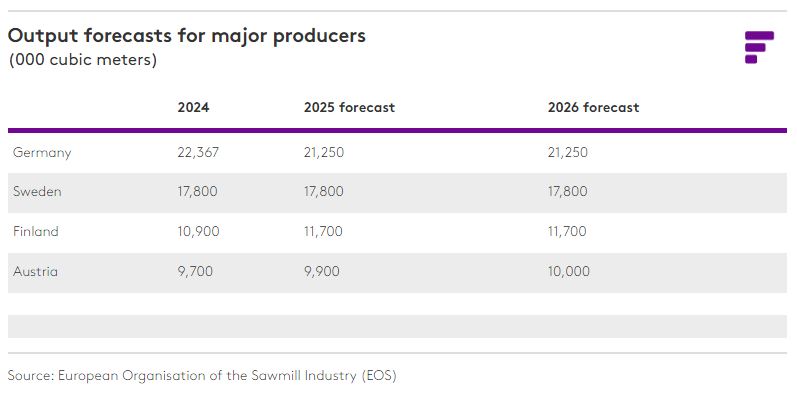
Germany has experienced the steepest production decline from
2021 peaks, while Finland shows recovery with a forecast
increase to 11.7 million cubic meters in 2025. Austria, Sweden
and, among smaller producers, Latvia and Norway, have largely
stabilized their output levels.
Consumption shows marginal growth
On the demand side, sawn softwood consumption across EOS member
countries plus the UK increased by 2.1% in 2024 to reach 42.8
million cubic meters, still 13% below 2021 levels. The European
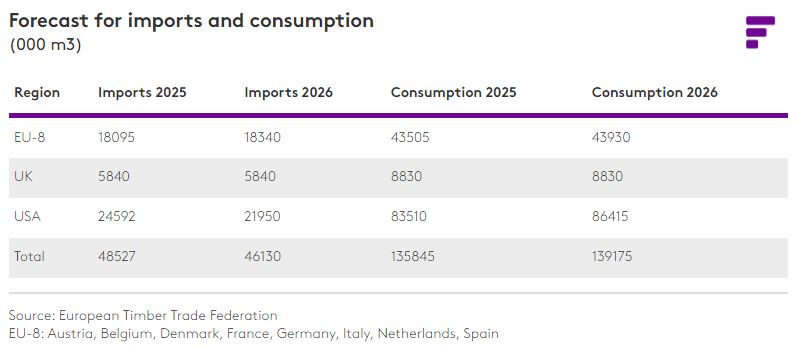
Timber Trade Federation (ETTF) forecasts consumption will edge
upward to 43.5 million cubic meters in 2025 and 43.9 million
cubic meters in 2026.
“For the third consecutive year, the first two quarters of 2025
offered hope in some European countries with increasing exports
and European consumption – slightly and from a relatively low
basis,” Sneck noted. “The summer was disappointing and the
feeling across the industry is that the next few months will not
be great.”
Import volumes tell a similar story of modest recovery. Total
imports to major European markets reached 48.2 million cubic
meters in 2024, up by 5.4% from forecasts made the previous
year. For 2025, ETTF Vice-President Morten Bergsten projects
imports of 48.5 million cubic meters, with a slight decline to
46.1 million cubic meters in 2026, driven primarily by reduced
US imports.
Raw materials prices squeeze profitability
A critical challenge facing European sawmillers is the dramatic
increase in raw materials costs, particularly in Nordic
countries where log prices have reached record highs. In
Finland, the spruce log price index has risen to approximately
160 (base 2015=100), while sawn spruce prices have increased to
only about 150, creating a significant margin squeeze.
“Sawnwood prices have grown but they have not kept pace with the
increase of log prices, which is one of the main reasons for the
low profitability of the industry,” Sneck emphasized. “The
increase in log prices took place in the middle of weak demand
for wood. What will happen when demand resumes?”
The situation differs somewhat in Central Europe, where prices
haven’t risen as sharply as in the north but remain high
compared with global competitors. A notable price gap has
emerged between fresh logs and beetle-damaged logs in countries
like Germany and the Czech Republic.
Spruce scarcity reshapes supply dynamics
Looking ahead, spruce availability is emerging as a
structural constraint on European production. Germany’s spruce
stocks are projected to decline dramatically from 1.2 billion
cubic meters in 2012 to just 300 million cubic meters by 2100,
according to data presented at the conference. The Czech State
Forests harvest has stabilized at around 8 million cubic meters
per year after peaking above 14 million cubic meters in 2020
during the bark beetle crisis.
“Due to climate change and its relative lack of suitability in a
warming climate, availability of spruce logs will decline in the
next few decades,” Sneck warned. “We already see the first
effects with reduced availability of spruce logs in the
aftermath of the bark beetle crisis a few years ago.”
This scarcity is driving mills in Central Europe and southern
Sweden to increase their use of pine as an alternative. From a
structural perspective, pine and spruce often meet the same
strength classification grades, though they differ in
appearance, handling, and treatment performance.
“The industry should do more to also promote pine as a
structural timber, as the share of pine in production will
increase compared with spruce,” Sneck urged.
Construction sector shows signs of bottoming out
The construction downturn that began in 2022 appears to have
reached its nadir. EU building permits for new dwellings
declined by 15% in floor area in 2023 and by a further 2% in
2024, with the dwelling index stagnating last year. However,
recent monthly data show permits may have bottomed out and are
displaying slight improvement.
“Confidence in the construction sector is still quite low but
the issuance of building permits for new houses in the EU has
reached its lowest point and is displaying slight improvement,”
Sneck observed. “Yet, the granting of permits is still very low
compared with 2021, especially in Central Europe.”
Large markets with traditionally high wood consumption have been
particularly hard hit, with Germany, France, Finland, and
Austria all experiencing significant permit declines. Spain
stands out as a positive outlier with expanding construction
activity.
Bergsten’s outlook for individual markets reveals mixed
conditions:
Germany: Gradual rebound expected, driven by public works and
energy renovation
France: Moderate recovery supported by green transition and
increasing building permits
Spain: Strong expansion continues, fueled by housing deficit and
renovation activity
Italy: Stabilizing with a potential small decline as PNRR
(recovery plan) stimulus winds down
Netherlands: Growing market driven by bio-based building
policies
Denmark: Moderate recovery linked to green transition and lower
interest rates
Despite these challenges, wood construction continues to gain
market share. In Germany, the share of new residential building
permits using wood as the predominant material reached 24.1% in
2024, up from 20.4% in 2020. Swedish data shows similar trends
in multi-dwelling buildings, where wood’s share has risen from
around 10% in the mid-2000s to 15-16% in recent years.
Export markets provide mixed picture
EU exports of sawn softwood to non-EU markets totaled €6.5
billion in 2024 ($7.48bn), up by 13% in the first half of 2025
compared with the same period in 2024. The US remains the
largest single destination outside Europe, accounting for over
16.5% of extra-EU exports, followed by Japan (9.4%) and Egypt
(6.4%).
However, China’s share has collapsed to just 2.2% as deliveries
fell by 37% in the first half of 2025 to only €85 million. The
UK, while technically outside the EU, can be considered part of
the European market and accounts for 26% of non-EU deliveries.
“In H1 2025, shipments to the US increased by 19% to €620
million, to Japan they declined by 7% to €350 million,” Sneck
reported. “Deliveries to Egypt grew by 8% to €240 million, while
deliveries to China went down by 37% to just €85 million.”
The US market outlook includes a forecast 10.7% decline in
imports for 2026 to 22 million cubic meters, though domestic
consumption is expected to rise by 3.5% to 86.4 million cubic
meters, suggesting increased domestic production will fill the
gap.
Russian competition persists in key markets
Russian lumber production has also declined from pandemic-era
peaks, stabilizing at around 28 million cubic meters annually,
down from over 32 million cubic meters in 2021. Russian exports
have fallen by approximately 40% since 2019 to 18.7 million
cubic meters in 2024.
China absorbs about 60% of Russian exports (11.2 million cubic
meters in 2024), though these volumes declined by 10% year over
year in the first half of 2025 as Chinese market prices remained
depressed. Russia is redirecting volumes to MENA (Middle East
and North Africa) and CIS countries, with an estimated 1.7
million cubic meters shipped to MENA in 2024, including 550,000
cubic meters to Egypt.
Notably, Russia still exports sizable quantities to Japan,
maintaining a presence in this important market despite EU
sanctions on Russian timber.
Industry calls for policy support
Both presenters emphasized the need for supportive policy
frameworks to enable recovery and address structural challenges.
Sneck highlighted the tension between sustainability regulations
and supply availability.
“We need to fight in Brussels and at the national level to show
policymakers that if we are serious about decarbonization,
European forests should not be seen as ‘green museums’ but also
as essential providers of wood,” he argued. “So, policies need
to reflect this.”
The presentations referenced numerous regulatory frameworks
affecting the sector, including the EU Timber Regulation (EUTR),
EU Deforestation Regulation (EUDR), and various certification
schemes (FSC, PEFC, DGNB ratings for buildings).
Bergsten struck a cautiously optimistic note about the sector’s
direction: “Europe is on the path to recovery, and our business
– our trade, our industry – is looking ahead to a slightly more
positive 2026. Despite many uncertainties, especially on the
political and regulatory level, wood remains the
future–naturally.”
Outlook: cautious optimism
The consensus outlook for 2025-2026 reflects modest improvement
from a low base, with consumption forecast to increase by
approximately 2.5% compared with 2024 levels. However, this
growth remains well below what would be needed to support an
accelerated green transition in European construction.
“In the short term the situation will remain difficult for the
European wood industry,” Sneck concluded. “There is renewed hope
for 2026, but the industry has already been disappointed over
the last couple of years.”
Key questions for the sector include whether construction
markets have truly bottomed out, whether the second half of 2026
will bring stronger recovery, how the industry will adapt to
reduced spruce availability, and whether log prices will
moderate to restore profitability.
With Europe having underbuilt housing for nearly 20 years,
increasing renovation requirements for energy efficiency, and
wood’s growing market share as a building material, the
fundamentals suggest potential for stronger growth. Whether 2026
marks the turning point remains to be seen, but both producers
and traders are positioning for gradual improvement while
managing continuing structural challenges.
Source:
fastmarkets.com


