Ready or not, help is on the way for North Carolina’s
beleaguered furniture manufacturers.
President Donald Trump is turning to his favorite weapon,
massive tariffs on foreign goods slapped together with little
notice, to revive furniture manufacturing in a state haunted by
jobs shipped overseas over the past two decades.
Yet some furniture executives worry that this help from the
federal government will do more harm than good to an industry
grappling with notoriously thin profit margins, a shortage of
skilled workers and whiplash from other tariffs.
Exhibit A: Alex Shuford, CEO of 78-year-old Rock House Farm
Furniture, who, in theory, would benefit from these levies.
But like others in the industry, Shuford has mixed feelings
about the tariffs and the way Trump’s plan has been rolled out.
He appreciates the “admirable” desire to revitalize North
Carolina manufacturing, but warns of collateral damage in the
interconnected global furniture ecosystem.
“We’ve got to be really careful that the effort to save us
doesn’t do more damage than good,” Shuford told CNN.
Rock House runs 11 factories that make furniture domestically,
but some of its brands also import furniture from overseas.
Roughly 80% of its sales are from furniture made in North
Carolina, with the rest imported.
New tariffs of 25% kicked in Tuesday on imported kitchen
cabinets, vanities and upholstered wooden furniture. On January
1, levies for upholstered furniture are scheduled to increase to
30% and cabinets and vanities to 50%.
While some furniture companies that make 100% of their furniture
in the United States could be helped by Trump’s furniture
tariffs, others that import some or all of their products will
be hurt.
And Shuford is concerned about unintended pain for the retailers
and distribution companies the entire industry relies on to sell
furniture.
“Frankly, I’m worried that we’ll have some retailers that decide
they can’t make it through,” said Shuford, whose grandfather
founded the company. “And then it hurts us all. The whole
ecosystem gets damaged.”
‘We’re not going back’
Trump has claimed his furniture tariffs will spark a boom in
domestic manufacturing.
In a Truth Social post late last month, Trump said the levies
will “make North Carolina, which has completely lost its
furniture business to China, and other Countries, GREAT again.”
And Trump has a point. As recently as 1999, North Carolina laid
claim to about 80,000 furniture manufacturing jobs.
But the vast majority of those jobs have since vanished.
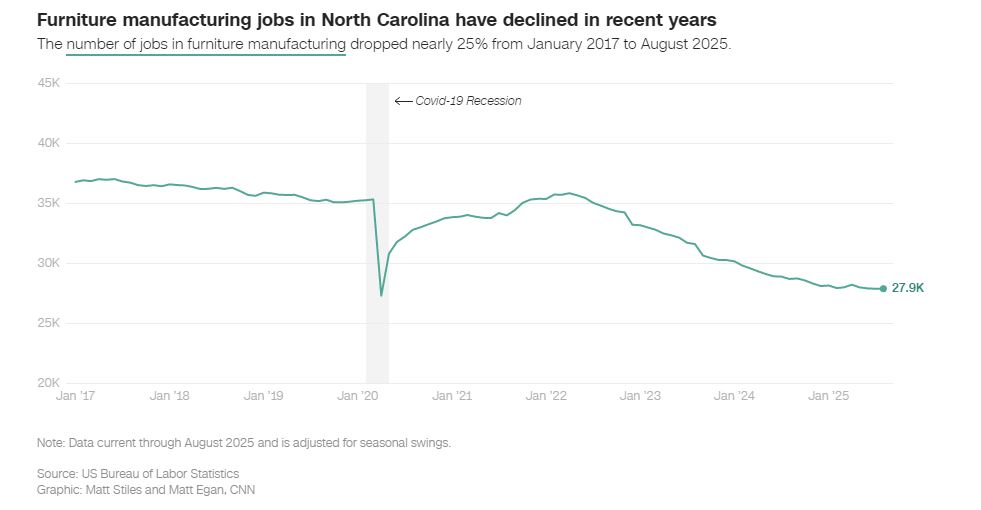
North Carolina had just 28,000 furniture jobs as of August, the
most recent month federal data was available. Apart from the
pandemic era, furniture employment is at its lowest level since
at least 1990.
While some furniture executives think Trump’s tariffs could help
reshore some jobs, they’re skeptical about a dramatic revival —
especially in the near-term.
“We’re not going to see the entire industry come back,” Shuford
said.
David Johnston, vice president of the Furniture Manufacturers
Credit Association, is tapping the brakes on mass reshoring
talk, too.
“We’re not going back to the heyday of the 1990s. But we will
get more expensive furniture,” Johnston, who grew up just
outside High Point, North Carolina’s furniture hub, told CNN in
a phone interview.
------------
---------
------
Source: edition.cnn.com


