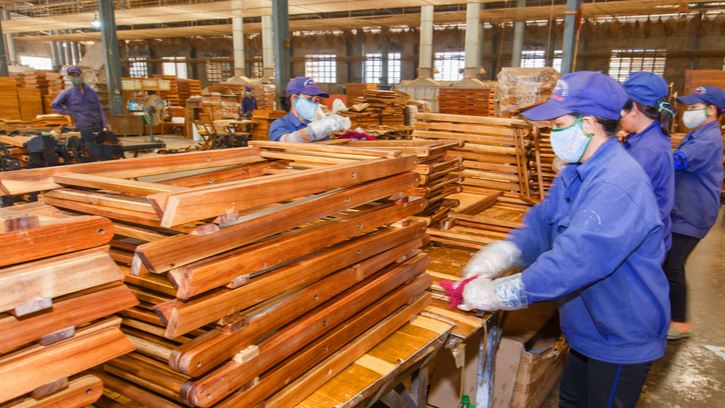
Woodworking industry is among the agricultural export sectors
with the highest value, contributing significantly to export
growth and the country’s economic development. However, new
challenges such as tariffs, legal raw materials, and reduced
purchasing power from major export markets pose difficulties,
forcing enterprises to restructure and enhance their
competitiveness in order to survive and develop sustainably.
Currently, there are over 5,000 enterprises engaged in wood and
timber product processing across Viet Nam, of which private
enterprises account for 95%. About 3.5% have capital investment
exceeding 50 billion VND. Approximately 2,000 enterprises are
involved in producing wood products for export, with domestic
companies holding a 65% market share.
Market pressures
According to the Viet Nam Timber and Forest Product
Association (VIFOREST), exports of wood and timber products
continue to maintain steady growth in major markets. Exports to
the US market are higher than the same period last year, while
exports of wood chips and pellets to Japan, China, and the
Republic of Korea (RoK) are maintaining good growth rates. The
EU market, mainly for indoor and outdoor wooden furniture, has
also seen slight growth.
However, Vietnamese wood export enterprises are facing two major
challenges. Firstly, the US market, which contributes over
54–56% of total wood export revenue, has been affected by a 20%
retaliatory tariff policy, announced by the White House on
August 1.
In the EU market, Vietnamese enterprises contribute
significantly to the segments of indoor and outdoor furniture
and wood pellets, averaging over 1 billion USD annually.
Recently, the EU enacted the EU Regulation on Deforestation-Free
Supply Chains (EURD), prohibiting the import of agricultural
products such as coffee, rubber, soybeans, wood, and palm oil
with links to deforestation globally. This regulation will take
effect in January 2026.
Given these challenges, Vietnamese enterprises have striven to
meet the stringent commitments on building sustainable supply
chains, avoiding deforestation, and complying with international
standards.
Other key export markets, including Japan, China, and the RoK,
also present challenges related to timber origin verification,
environmental protection requirements, compliance with green
production standards, and greenhouse gas emission reduction.
Pressures from export markets also present opportunities for
enterprises to reconsider their growth models, increase
adaptability, and respond effectively to external market
fluctuations.
According to VIFOREST Vice Chairman Ngo Sy Hoai, the global
economic volatility in 2025 and beyond, along with geopolitical
conflicts, will affect transportation costs, raw wood prices,
and trade regulations, impacting export activities.
Nevertheless, he pointed out that these pressures from export
markets also present opportunities for enterprises to reconsider
their growth models, increase adaptability, and respond
effectively to external market fluctuations.
He stressed that growth can no longer rely on comparative
advantages such as cheap raw materials and low labour costs; it
must shift towards competition based on quality and branding.
Moreover, enterprises need to expand and restructure export
markets to diversify.
Many potential markets such as China, Japan, and other markets
like the UK, Russia, the Middle East, South America, and ASEAN
remain underexploited. This new segment presents great
opportunities for enterprises to advance and enhance their
competitiveness for sustainable exports.
Enhancing competitiveness
Vietnamese exports of wood and timber products have risen
steadily every year, from 6.9 billion USD in 2015 to a strong 16
billion USD in 2024, with a projected increase to over 18
billion USD by the end of this year.
Therefore, building and developing stable raw material sources
is an essential requirement to enhance the competitiveness of
enterprises.
Currently, domestic forest product raw materials meet only about
70% of the production and processing needs of enterprises.
Regarding timber, Viet Nam still imports an average of 5.5–6
million cubic metres of raw wood annually. According to the
Forest Trends, Viet Nam has become an important global supplier
of wood products.
Alongside securing stable raw materials, enterprises must
promote the application of science and technology, creating new
structural designs and models to meet market demands, especially
for the high-end product segment.
The global furniture and wood product trade market holds great
potential, with a trade value of approximately 430 billion USD
for indoor furniture and 150 billion USD for outdoor furniture.
Viet Nam’s wood and forest product exports only account for
about 6% of the global market share.
Thus, enterprises need to maintain stable growth in current
markets, seek to expand into new and potential markets, and
foster negotiations and implementation of forestry cooperation
programmes with key countries, especially with countries
boasting high trade values.
Source: nhandan.vn


