|
Report from
Europe
July data confirm renewed downturn in EU furniture
production
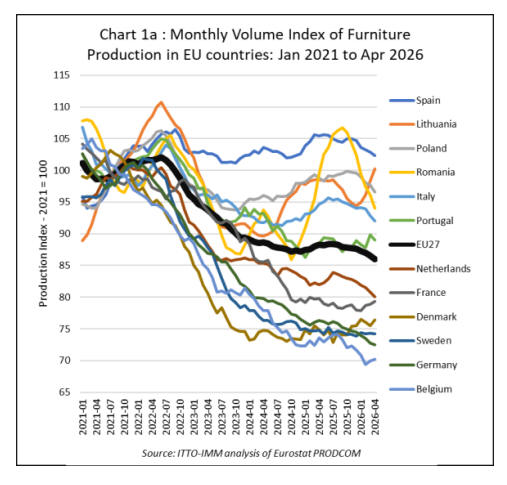
Eurostat’s July update confirms that the tentative
stabilisation in EU27 furniture production during 2025 did
not extend into 2026. Seasonally and calendar-adjusted
output in January to April was 3.7% lower than a year
earlier.
Production declined 5.6% in Germany, 4.5% in Italy and
4.2% in the Netherlands whilst Belgian output was also
down 5.5% in January to March. Poland, Spain and
Romania recorded an average decline of 5.6%. The
principal exceptions were Lithuania, where output
increased 4.7%, and France, up 2.5%.
However, such gains were insufficient to offset declines
elsewhere, leaving EU27 production 3% lower in the
opening four months of 2026 (Chart 1a)
Indicators point to only limited support for furniture
demand
Analysis of CSIL data indicates that European furniture
consumption increased by 1.8% to €112 billion in 2025,
from €110 billion in 2024, but remained 6.7% below its
2022 peak.
Most of the increase came from extra-European supply:
consumption met by production within Europe edged up
from €85 billion to €85.5 billion, while imports from
outside Europe rose 6% from €25 billion to €26.5 billion.
Extra-European imports therefore accounted for 75% of
the increase (Chart 1b).
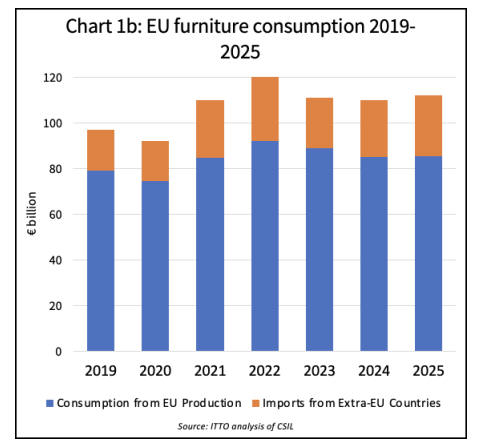
Extra-European suppliers accounted for 23.7% of
European furniture consumption in 2025, compared with
18.6% in 2019. Over the same period, imports increased
47.2%, from €18 billion to €26.5 billion, while
consumption supplied by European production increased
only 8.2%, from €79 billion to €85.5 billion. The July
market position therefore combines weak underlying
demand with a continuing rise in import penetration.
Economic indicators released in July were mixed. EU
retail trade rose 0.5% month-on-month in May, including
a 0.5% increase in non-food sales excluding automotive
fuel. DG ECFIN’s July flash estimate showed EU
consumer confidence improving by 1.9 percentage points
to -15.1.
This was the third consecutive monthly improvement,
although confidence remained below its long-term average
and had not recovered the losses recorded since February.
The euro-area household saving rate stood at 14.3% in the
first quarter.
The Iran war remained the principal downside risk to the
July outlook. Euro-area inflation eased from 3.2% in May
to 2.8% in June, but energy inflation remained at 8.5%. On
23 July, the European Central Bank held its three key rates
unchanged following its June increase, noting that energy
prices remained well above pre-conflict levels and that the
full inflationary impact had yet to emerge.
EU house prices were 5.1% higher year-on-year in the first
quarter, while dwelling transactions fell in nine of the
sixteen reporting Member States, leaving little evidence of
a broad housing-led stimulus to furniture demand.
Commission completed EUDR simplification package
in July
The Commission’s July measures confirmed that the EU
Deforestation Regulation (EUDR) will apply from 30
December 2026 to large and medium-sized operators and
to micro and small operators already covered by the EU
Timber Regulation. Other micro and small operators will
follow from 30 June 2027.
The Commission’s May review of EUDR estimates that
the combined simplifications will reduce recurring
compliance costs by around 75% and concluded that no
further amendment of the basic legal text was required.
The Information System Implementing Act adopted in
July provides for simplified declarations by micro and
small primary operators in the EU. A separate Delegated
Act would exclude waste, used and second-hand goods,
samples and certain packing materials, but remains subject
to scrutiny by the European Parliament and Council before
entering into force.
The package reduces repetitive reporting inside the EU but
does not remove the traceability burden for composite
products, mixed origins or supply based on numerous
smallholders for products imported from outside the bloc.
Trade data confirm widening import-export gap
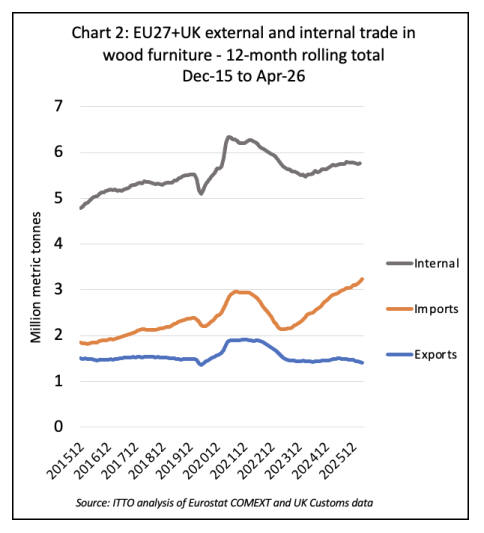
EU COMEXT and UK Customs data available in July
show that EU27+UK wooden furniture imports from
outside the region reached a twelve-month rolling total of
3.24 million tonnes in April 2026, 11.3% more than a year
earlier and the highest level in the series. Exports fell 6.7%
to 1.40 million tonnes, widening the external trade gap to
1.84 million tonnes (Chart 2).
The latest observation extends the import recovery evident
since the second half of 2023, whilst exports remain close
to the low range established after the 2021–22 peak.
The most recent internal-trade observation, a twelve-
month rolling total of 5.76 million tonnes in March, was
broadly flat. Internal trade remains substantially larger
than either external flow, but the July data point to extra-
European supply as the main source of current trade
momentum.
Import breakdown confirms further gains for China
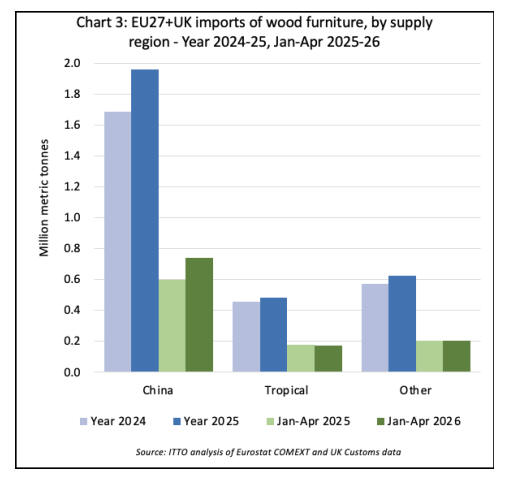
The latest available data by origin show that EU27+UK
wooden furniture imports from China increased 23.5% to
741,500 tonnes in January–April 2026. China supplied
approximately two-thirds of extra-regional imports and
accounted for virtually the entire year-on-year increase in
import volume (Chart 3).
Inversely, imports from tropical countries fell 2.6% to
174,000 tonnes, whilst imports from other suppliers
remained unchanged at around 200,000 tonnes, indicating
a further concentration of European import growth on
Chinese supply.
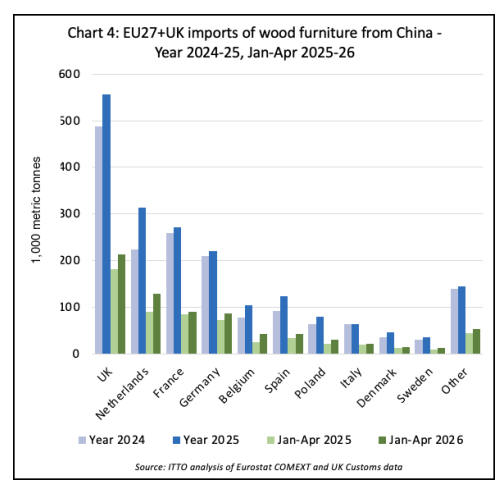
The UK remained the largest destination for Chinese
wooden furniture, with January to April imports up 17.3%
to 214,200 tonnes. The Netherlands rose 44.1% to 129,600
tonnes, while France and Germany received 89,900 tonnes
and 86,900 tonnes respectively. Belgium recorded the
fastest percentage increase, at 72.5%. Imports into EU
Member States collectively increased 26.3%, compared
with 17.3% in the UK (Chart 4).
In upholstered furniture, CSIL attributes rising Chinese
penetration to the price thresholds imposed by major
volume retailers, which even lower-cost European
producers are struggling to meet. The renewed rise in oil
prices and shipping risk in late July adds uncertainty to the
sourcing outlook.
Higher bunker, insurance and inventory costs will raise the
landed cost of Asian furniture, although there is little
evidence so far that the increase is substantial enough to
erode China’s underlying price advantage.
Tropical wooden furniture imports lose share
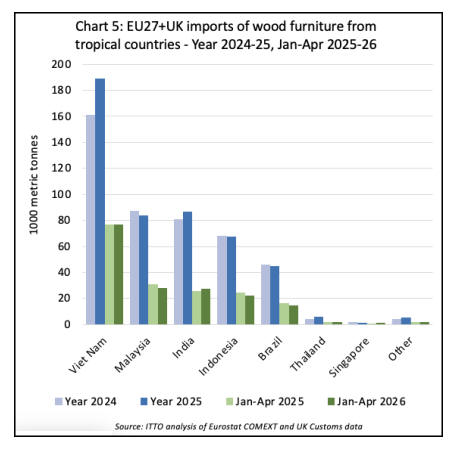
EU27+UK imports from tropical suppliers fell 2.6% to
174,000 tonnes in January to April 2026. Viet Nam was
unchanged at 77,000 tonnes and India increased 7.8% to
28,000 tonnes, but these results were outweighed by a
9.2% decline from Malaysia and falls of 11% from both
Indonesia and Brazil (Chart 5).
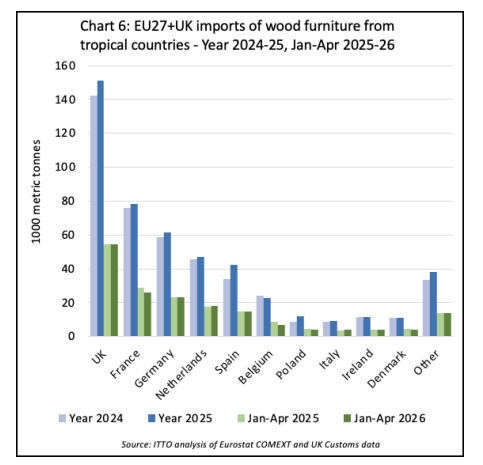
The UK remained the largest destination, accounting for
31.4% of tropical wooden furniture imports into Europe,
with volumes virtually unchanged at 54,600 tonnes.
France fell 9%, Belgium 17.4%, Denmark 16.9% and
Poland 11.8%; Germany and Spain were each down 1%.
Imports increased 8.6% in Italy and 4.8% in the
Netherlands (Chart 6).
The latest figures are consistent with a more selective
market for tropical wooden furniture. Traditional solid-
wood outdoor sets face increasing competition from
modular and mixed-material products, while the stronger
contract segment favours consistent specifications, shorter
production runs and dependable project delivery.
Indeed, CSIL’s June review of the European outdoor
furniture market identifies the increasingly blurred
distinction between indoor and outdoor collections as an
important product trend, reflected in improved finishes
and the wider availability of weather-resistant upholstered
ranges.
For tropical suppliers, this will likely mean greater
competition in a market where outdoor furniture must
offer the comfort and finish of an interior collection whilst
simultaneously remaining lightweight, weather-resistant
and easy to maintain. Such requirements have tended to
favour aluminium frames, synthetic fibres and engineered
composites over solid-wood construction.
The decline in the tropical share of extra-regional imports
from 18.3% to 15.6% is consistent with growing pressure
on conventional tropical hardwood sets. Wood is unlikely
to disappear from the category, but its role may
increasingly shift towards visible components and
detailing within higher-value mixed-material collections.
Suppliers able to respond to this hybrid market, while
providing credible product-level evidence of legal and
deforestation-free origin, should be better placed to defend
market share.
Outdoor furniture offers selective rather than broad
growth
According to CSIL, the European outdoor furniture market
was valued at more than €3 billion in 2025 and is expected
to contract slightly in 2026. Germany, the UK, Italy and
France remain the largest national markets. Competition in
July is therefore centered on securing share within a flat-
to-declining market rather than responding to growth in
overall demand.
The renewed oil and shipping shock in late July
underscores the importance of production and freight
efficiency. Escalating hostilities around the Strait of
Hormuz pushed fuel and bunker costs sharply higher,
prompting the likes of CMA CGM to introduce an
emergency surcharge of up to $150 per dry container on
long-haul routes from 1 August.
The pressure extends to flexible foams, synthetic fibres,
resins, adhesives and many protective coatings depending
on petroleum- or natural-gas-derived feedstocks, all
important inputs for furniture manufacturing. Such
disruption highlights that export competitiveness in the
furniture sector now depends not only on design quality
but also on level and cost of access to material inputs and
the efficiency of manufacturing.
Global wooden furniture trade loses momentum
Updated ITTO estimates indicate that global wooden
furniture exports fell 0.9% to US$75.2 billion in 2025, less
than the 3.2% decline initially projected. Exports reported
by EU Member States, including intra-EU dispatches,
increased 5.1% to US$30.7 billion, while China’s exports
fell 10% to US$20.4 billion.
The first-quarter figures show a clearer deterioration in
2026: global exports fell 3.3% to US$16.8 billion and US
imports declined 25.3% to US$4.0 billion. The 25% US
tariff on certain upholstered furniture, kitchen cabinets and
vanities remains in force.
By making imported furniture less competitive in the US,
the tariff gives Asian manufacturers with capacity
previously directed towards that market a stronger
incentive to seek orders elsewhere.
Any diversion will be concentrated in the affected product
categories, but it is likely to intensify price competition in
Europe and further narrow the space available to tropical
suppliers without a clearly differentiated offer. Weak US
demand continues to create an incentive to redirect supply
towards Europe, although the Iran-war energy shock and
renewed disruption risk around Hormuz and Bab-el-
Mandeb are raising the cost and uncertainty of that
redirection.
European market position in July 2026
The July indicators suggest that market conditions are
stabilising at a subdued level, with little evidence yet of a
sustained recovery. European consumer confidence
improved and May retail trade was firmer, but confidence
remains below its long-term average with an elevated
saving rate and weak housing transactions. The ECB’s
decision on 23 July to hold rates leaves financing
conditions tighter than anticipated before the Iran war.
Consequently, energy has re-emerged as the principal
near-term risk with the IEA’s July assessment indicating
that, despite a sharp rebound in June, global oil supply
remained materially impaired at 9.4 million barrels per day
below its pre-war level, whilst refined-product margins
reached four-year highs in early July.
Renewed hostilities subsequently pushed Brent briefly
towards US$100 per barrel. For the furniture sector, the
immediate effects will be transmitted through freight, fuel
and petroleum-derived inputs such as foam, resins and
coatings, together with higher inventory and working-
capital costs, rather than through any immediate direct
constraint on timber availability.
The principal implications for the wooden furniture sector
in Europe at the end of July are:
• Chinese supply remains the main competitive
pressure in European mass-market furniture,
although higher freight, energy and inventory costs
may narrow landed-cost differences.
• The UK remains the largest European destination
for tropical wooden furniture. The Netherlands is
comparatively firmer, while France weakened and
Germany and Spain were broadly stable in the latest
data.
• Tropical suppliers are better positioned in contract-
grade, modular and mixed-material products than in
standard heavy solid-wood sets.
• Exposure to Red Sea and Gulf disruption should be
reflected in freight, insurance, lead-time and
inventory planning for late-2026 orders.
• The July simplifications of EUDR will likely reduce
reporting but do not alleviate plot-level traceability
requirements for upstream operators outside the EU.
• Certification and origin claims will carry
commercial value only where they are supported by
accessible product-level evidence that European
buyers can incorporate directly into due-diligence
systems.
The market position remains cautious with marginal
improvement in confidence and retail activity being offset
by weak production, subdued housing turnover, tighter
financing and renewed energy-market disruption.
|


