|
Report from
North America
Imports of Chinese hardwood and related products – a
huge decline
The US Census Bureau reported that the US imported
US$60.87 billion worth of goods from China in 2026
through March, compared to US$102.66 billion over the
same period in 2025, a 41% drop.
Imports from China have nosedived since last year,
showing how seriously US tariffs have shaken up global
trade routes and affected what US shoppers see on store
shelves. US imports of tropical hardwoods and products
from China took similar dive this year with some home
essentials seeing even larger declines.
Wooden furniture imports from China are down 54% so
far this year. Imports fell to just over US$80 million in
April, the lowest monthly level in at least 15 years. As
recently as 2021, these imports averaged more than
US$400 million per month.
Imports of hardwood plywood from China are down 65%
and have fallen further each month this year. In September
2025volumes fell below 1,000 cubic metres for the first
time since 2010 and have averaged less than 1,000 cubic
metres per month since then.
Over the first four months of the year, imports of
hardwood mouldings from China were down 84%, imports
of hardwood flooring from China down 40% and imports
of assembled flooring panels down 73%. While imports of
tropical hardwood veneers from China were up 13% for
the year to date ( they dropped to zero in April).
See: https://apps.fas.usda.gov/gats/default.aspx
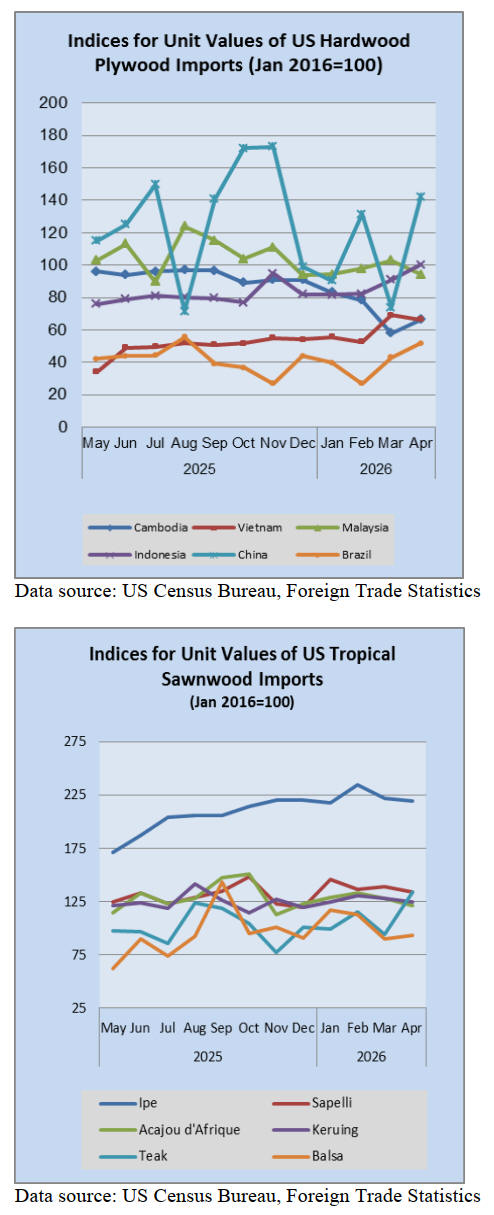
Sawn tropical hardwood imports showed modest gains
in April
US imports of sawn tropical hardwood in April rose 2%
over the previous month both in volume and in value. At
15,776 cubic metres the volume was up 9% from that of
April 2025. Imports from Malaysia and Ecuador both
jumped more than 70% while imports from Indonesia rose
37%.
Even with the gain, imports from Indonesia have been
much lower this spring than last year and are down 67%
for the year so far. Overall, US imports of sawn tropical
hardwood are slightly higher than last year, up 3% through
April.
In Canada, April imports fell 18% from the previous
month and were down more than 34% from April of last
year. Through April, Canada’s imports of sawn tropical
hardwood are down 18% versus 2025.
See:https://apps.fas.usda.gov/gats/default.aspx
and
https://ised-isde.canada.ca/site/trade-data-online/en
Hardwood plywood imports continue to slide
US imports of hardwood plywood fell for a third
consecutive month, dipping 5% in April from the previous
month. The 163,180 cubic metres imported in April was
28% less than that of a year ago.
Imports from China and Indonesia continue to weaken.
Both were down 65% for the year as imports from China
fell 39% in April and imports from Indonesia sank by
13%.
Imports from Vietnam are also way down, falling 30% in
April and down by half for the year so far. Total US
hardwood plywood imports for the year so far are down
32% from the previous year.
See: https://apps.fas.usda.gov/gats/default.aspx
Veneer imports surge again
For the second consecutive month, imports of tropical
hardwood veneers showed solid growth, gaining 48% in
April after a 34% rise in March.
Imports from top-supplier Cameroon surged by 241% to
their highest monthly level since August 2023, while
imports from both Italy and Cote d’Ivoire more than
doubled.
Imports from Ghana saw a steep decline in April but are
still 114% over last year for the year. Total imports of
tropical hardwood veneer are up 19% versus 2025 through
April.
See: https://apps.fas.usda.gov/gats/default.aspx
Hardwood flooring and flooring panel imports retreat
in April
After showing a promising rebound in March, imports of
hardwood flooring retreated in April, falling 12% from the
previous month. At under US$3.94 million, imports were
at their lowest value for an April since 2017.
Imports from China fell 71% for the month and are down
40% year to date. Imports from Brazil are also sluggish,
down 56% for the month and 66% for the year so far.
Total imports of hardwood flooring are off 23% in 2026
versus last year.
The story is the same for Imports of assembled flooring
panels. A surge in March was followed by a pullback in
April as imports fell 15%. The US$25.5 million in
imported panels for the month was down 20% from the
previous April.
Imports from top-suppliers Canada and Vietnam both fell
by more than 10% for the month, while April gains in
imports from China and Indonesia did little to make up for
very low totals from those countries earlier this year. For
the year so far, imports of assembled flooring panels are
down 17% versus last year.
See: https://apps.fas.usda.gov/gats/default.aspx
Moulding imports flatten
US imports of hardwood moulding were flat in April,
rising less than 1% from the previous month. At US$13.8
million, imports were down 7% from April 2025 as
imports from China continue to erode.
Imports from China fell 56% in April and are down 84%
for the year so far. Imports from Malaysia fell 15% in
April while imports from top-supplier Canada rose 20%.
Overall, imports of hardwood moulding are down 14%
versus 2025 through April.
See: https://apps.fas.usda.gov/gats/default.aspx
Wooden furniture imports slump again
US imports of wooden furniture fell 13% in April,
showing no momentum after a surge in March. At
US$1.21 billion, imports for the month were as bad as
February’s low but were 29% below those of April 2025.
Imports from China fell 28% in April to just over US$80
million, which is the lowest level in a least 15 years and is
only the second time in the last decade they have fallen
below US$100 million.
Imports from Vietnam fell 22% and are down 21% for the
year so far. Total imports of wooden furniture are down
26% for the year to April versus 2025.
In the US furniture market new residential furniture
orders rose 1% in March compared to the previous month,
but were down 2% compared to March 2025's numbers,
according to the May issue of Furniture Insights.
Approximately 60% of participants reported increases
versus decreases in March compared to a year ago.
Shipments were also up 6% compared to February, and up
2% over March 2025, with approximately one-half of the
survey participants reporting increases compared to the
year prior, according to Mark Laferriere, assurance partner
at Smith Leonard, the accounting and consulting firm that
produces the monthly report.
On a seasonally adjusted basis, sales at furniture and home
furnishings stores in April were down 2% compared to
March 2026. Year to date on a non-adjusted basis, April
sales were down 3% compared to 2025, according to
May's Furniture Insights.
In his comments, Laferriere noted that while current
events "continue to be a drag on consumer confidence as
well as aggravating existing inflationary pressures,
particularly on freight rates and certain raw material
costs," on the retail side, "Memorial Day activity was
largely positive despite the current headwinds." Tariff
refunds are also having a positive impact.
See: https://usatrade.census.gov/index.php?do=login
and
https://www.smith-leonard.com/category/furnitureinsights/
and
https://www.woodworkingnetwork.com/furniture/march-
residential-furniture-orders-rise-1-february-fall-short-last-year
Order to toughen Customs enforcement
On 3 June the US President signed an Executive Order
that he claims will strengthen the enforcement of US
Customs laws.
According to the president, Customs reform is long
overdue. "Systemic inefficiencies, loopholes, insufficient
enforcement mechanisms,and outdated processes have
created opportunities for malign actors to evade federal
law," the order reads.
The order directs the Department of Homeland Security
(DHS) and US Customs and Border Protection (CBP) to
strengthen several requirements for Importers of Record
(IORs). Examples include:
increasing bonding requirements and requiring
IORs to maintain at all times a minimum level of
tangible domestic assets, bonding, or both;
subjecting foreign importers-of-record (IORs) to
heightened requirements for formal entry;
authorising only US IORs to file informal entry;
imposing a “good standing” requirement on all
IORs; and
increasing vetting procedures for all individuals
and entities that conduct activities directly related
to the importation of goods.
The Order directs DHS and CBP to establish various
disclosure and certification requirements designed to
combat duty evasion and noncompliance with supply
chain rules.
The Order directs DHS and CBP to increase enforcement
of existing customs laws, including by establishing a 50%
minimum penalty floor limiting CBP’s discretion to
reduce the assessed penalties on importers who violate US
customs laws.
“Examples of noncompliance include undervaluing
imports, withholding critical information about IORs and
the goods being imported, and avoiding payment of duties
through various arrangements and schemes,” the order
said.
The Order directs DHS to enhance the seizure and disposal
of non-compliant imports, including by reducing
regulatory burdens to voluntary abandonment and
authorizing third-party disposal.
The Order directs DHS to enhance transparency in
customs, including by publishing annual transparency
reports and to propose legislation to strengthen customs
enforcement. The order also ramps up the use of artificial
intelligence by customs authorities.
On 2 June US Trade Representative, Jamieson Greer,
published a report saying 60 economies the US does
business with fail to impose or effectively enforce
prohibitions on importing items into their countries that
were made by people who were working against their will
or for insufficient funds.
Greer proposed a minimum 10% across-the-board tariff on
all of the trading partners the administration investigated,
citing authority from Section 301 of the Trade Act of
1974.
Several trading blocs that had previously entered into trade
negotiations with the United States, including Canada,
Mexico, the European Union, Ecuador, Indonesia and
Pakistan would be subject to the new 10% tariff.
Many other countries would face a steeper 12.5% tariff,
including China, Brazil, Japan and India. Those are the
trading partners the USTR maintains have not taken initial
steps to rid forced labour from their economies.
See:
https://www.woodworkingnetwork.com/news/woodworking-
industry-news/trump-signs-order-toughen-customs-enforcement
and
https://www.msn.com/en-us/money/news/trump-order-directs-
customs-to-crack-down-on-tariff-cheats/ar-
AA24M4gS?ocid=BingNewsVerp
and
https://www.whitehouse.gov/fact-sheets/2026/06/fact-sheet-
president-donald-j-trump-strengthens-customs-enforcement/
and
https://ustr.gov/sites/default/files/files/Press/Releases/2026/UST
R%20Report%20Sec%20301%20FL%20301%206-2-
26%20FINAL%20for%20upload.pdf
USTR announces Section 301 investigation of Vietnam
The US administration on May 290 opened an unfair trade
practices investigation into Vietnam's intellectual property
protection policies and enforcement that may lead to new
tariffs or other trade measures.
A month ago, the US Trade Representative’s office
identified Vietnam as a priority country "due to its
persistent failure to resolve long-standing concerns about
IP protection and enforcement," the USTR said.
The probe coincides with a surge in Vietnam's exports to
the United States, which in the first three months of this
year led to a US trade deficit with Vietnam of US $54.8
billion, higher than those with major exporters China and
Mexico. The US administration has repeatedly said it
wants to reduce trade deficits.
https://www.msn.com/en-us/news/us/us-investigates-
vietnams-intellectual-property-practices/ar-
AA24qmvH?ocid=BingNewsVerp
See: https://ustr.gov/about/policy-offices/press-office/press-
releases/2026/may/ustr-announces-section-301-investigation-
vietnams-acts-policies-and-practices-related-intellectual
|


