Japan
Wood Products Prices
Dollar Exchange Rates of 10th
June
2026
Japan Yen 160.22
Reports From Japan
Bank of Japan discusses interest rate increase
The Bank of Japan (BoJ) is set to raise its key interest rate
to 1.0% from the current 0.75% at its policy board meeting
on 15 and 16 June as the Japanese economy faces upside
risks of inflations. The BoJ is also considering pausing the
tapering of its government bond purchasing program,
starting in April 2027.
"Even if the situation remains unclear, should it be judged
that upside risks to prices outweigh downside risks to
economic activity, it will be necessary to thoroughly
discuss the pros and cons of raising the policy interest
rate," said Kazuo Ueda, Governor of the BoJ
He also said that the BoJ should discuss raising rates if
inflation outweighs concerns about an economic
slowdown, suggesting it could proceed with a rate hike
despite the ongoing Middle East uncertainty.
According to BoJ data released last month, Japan’s
Corporate Goods Price Index for April rose 4.9% year on
year, marking the highest growth since May 2023.
If the BoJ falls behind in raising interest rates, rising prices
at the corporate level could spread, potentially accelerating
increases in the consumer price index.
A weak yen and higher crude oil prices driven by Middle
East tensions are pushing up import costs. Businesses are
becoming more aggressive in passing these costs onto
consumers, potentially causing underlying inflation to
exceed projections
While the Middle East conflict and geopolitical trade
scenarios remain key sources of uncertainty, hawkish BoJ
board members argue that keeping real interest rates
deeply negative poses a larger long-term risk to the
economy. Ahead of the June meeting, analysts see a high
probability of a rate hike as the BOJ continues its
normalisation path.
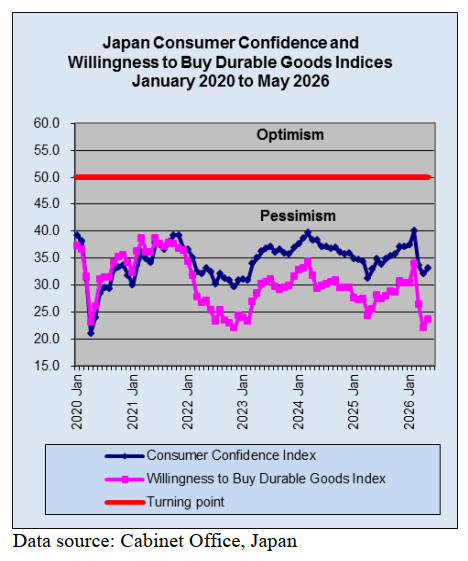
Upturn in Japanese household spending on furniture
According to the Ministry of Internal Affairs and
Communications household spending in Japan dropped
0.5% YoY in April 2026, easing from a 2.9% decline in
March and beating market expectations for a 1.5% fall.
While this marked the fifth straight month of contraction,
it was also the mildest decline suggesting that easing
inflationary pressures may be helping to support consumer
spending.
Expenditure on food fell at a slower pace, (-0.5% vs -2.9%
in March) while spending increased for transport and
communication (7.5% vs -16.8%), housing (7.6% vs
15.3%), furniture and household goods (19.0% vs 5.5%),
healthcare (6.7% vs 20.1%) and culture and recreation
(6.3% vs 4.6%).
Pledge to cut consumption tax but challenges remain
The government is considering lowering the consumption
tax rate on food to 1% for two years from next April. The
election pledge was for a zero rate but major cash register
system vendors have said that it would take around one
year to adjust systems for a zero percent consumption tax
rate, but only around half a year for a 1% tax rate.
While there is growing support for modifying the election
pledge in order to tackle rising consumer prices swiftly
even the 1% option would present challenges, especially in
securing about yen 4 trillion in annual funding for the tax
cut. The domestic media has reported that the government
may spend about yen 600 billion on subsidies for updating
cash registers.
According to a Mitsubishi Research Institute report a
consumption tax cut on food could hurts small farmers
because their outgoing costs for farming supplies remain
highly taxed, while the tax revenue they collect on the
food they sell drops. Because many small farms are
exempt from remitting consumption tax to the
government, a rate reduction will erode margins.
See:
https://www.japantimes.co.jp/news/2026/06/02/japan/takaichi-
food-tax-one-percent/
and
https://mainichi.jp/english/articles/20260614/p2g/00m/0na/00200
0c
Yen weakness reflects domestic conditions
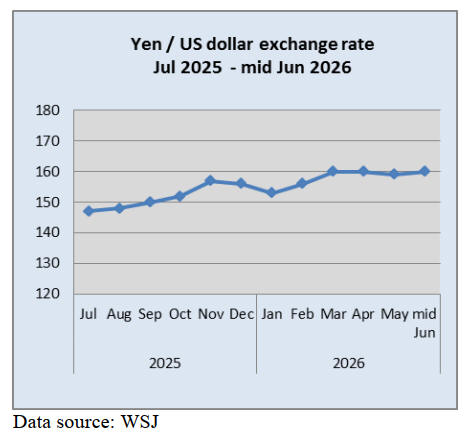
The yen remains weak due to a combination of cost-push
inflation, demographic pressures and wide interest rate
differentials with the United States. Sayuri Shirai of Keio
University, writing for the EastAsiaForum says, the yen’s
weakness increasingly reflects domestic conditions. One
key factor is the country’s heavy dependence on imported
energy. Rising oil and gas prices worsen the trade balance
and generate inflationary pressures.
Cost-push inflation suppresses purchasing power and
limits economic momentum. While rising nominal wages
are a positive development they have often lagged behind
increases in food and energy prices, leaving many
households under sustained pressure.
Real income growth remains weak and consumption
continues to recover only gradually. Even when external
pressures ease, there is little domestic support for a
rebound in the yen.
Analysts at Commerzbank note that Japan's structural
economic backdrop is showing clear signs of independent
strength. However, they argue that these domestic
improvements are currently overshadowed in the currency
markets as global commodity fluctuations and
international conflicts remain the primary forces
suppressing the yen's value.
See: https://eastasiaforum.org/2026/06/09/japans-structural-
constraints-reinforce-the-yens-new-normal/
and
See: https://www.tmgm.com/en/analysis/market-
news/article/japanese-yen-outlook-looks-weak-despite-
expectations-of-boj-rate-hike-202606091112
Japan’s real estate paradox
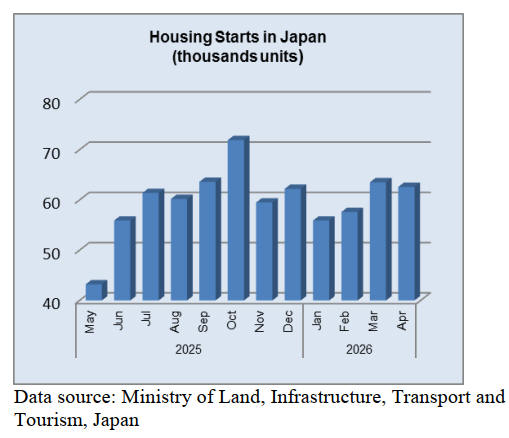
Japan is facing a real estate paradox defined by a chronic
oversupply of roughly 9 million abandoned homes (known
as akiya) in rural and suburban areas, paired with surging,
record-high, residential prices and bubble-risk concerns in
metropolitan hubs like Tokyo.
Unlike the housing crises in the US or Europe that stem
from inventory shortages, Japan struggles with an excess
of supply.
This issue is fueled by a shrinking, rapidly aging
population and a cultural reluctance to buy older
properties. Furthermore, tax incentives frequently
encourage property owners to build new houses on
inherited land rather than tearing down or selling old ones.
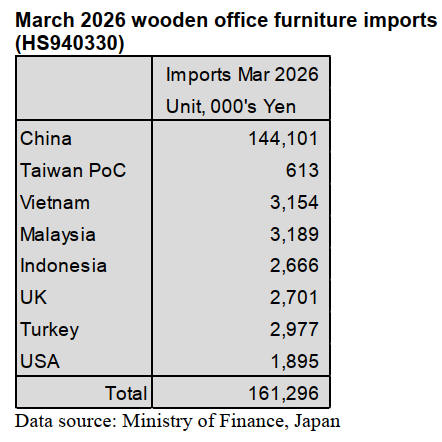
March 2026 wooden office furniture imports
(HS940330)
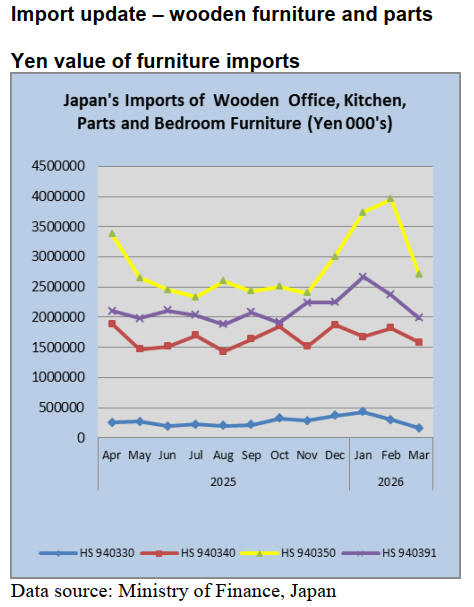
The top suppliers of wooden office furniture (HS940330)
in March 2026 were manufacturers in China, accounting
for 89% (86% in February) of imports. The other two main
suppliers were from makers in Viet Nam and Malaysia.
The top three shippers accounted for over 90% of Japan’s
March 2026 imports of wooden office furniture.
Surprisingly, there were no arrivals of HS940330 in March
from shippers in Europe with Turkey and the US being the
only non-Asian suppliers.
The value of March 2026 imports of HS940330 was down
46% from February and down 39% from March 2025. The
value of March imports from both Viet Nam and Malaysia
were down compared to that reported for February. The
decline in the value of March 2026 imports added to the
decline observed in February.
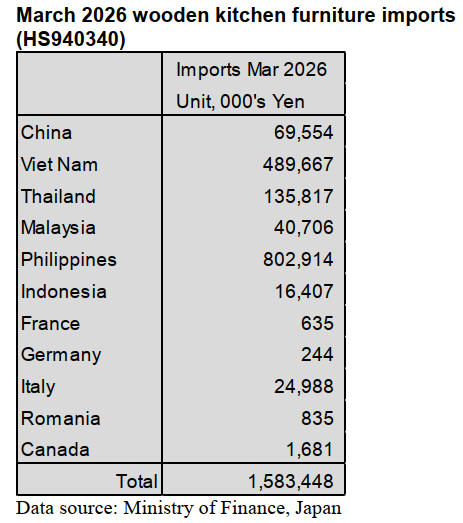
March 2026 wooden kitchen furniture imports
(HS940340)
Year on year the value of March wooden kitchen furniture
imports was down 13% and compared to February the
value of imports lower by 10%.
In March 2026, the top two shippers of wooden kitchen
furniture (HS940340) were the Philippines and Viet Nam.
These two countries accounted for over 80% of Japan’s
imports of wooden kitchen furniture in March.
The value of shipments from the Philippines in March was
the highest, accounting for 51% (49% in February) of the
total value of shipments of wooden kitchen furniture. The
other main supplier, Viet Nam, accounted for 31% (29%
in February) of the value of March imports.
The value of March shipments from the Philippines was
down month on month as was the value of shipments from
Viet Nam. The value of March arrivals from Shippers in
China was down month on month with only arrivals from
Malaysia posting month on month gains.
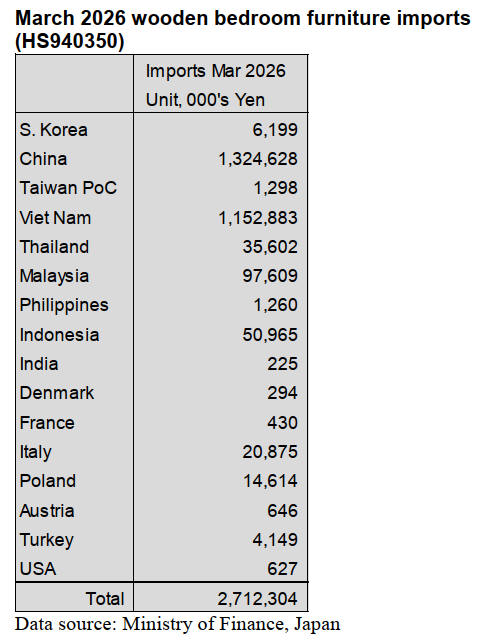
March 2026 wooden bedroom furniture imports
(HS940350)
The upward trend in the value of wooden bedroom
furniture (HS9403550), which began at the end of 2025,
ended abruptly in March. The value of March imports was
31% below that of February and 27% below that of March
2025. The value of March shipments from all four main
suppliers dropped when compared to a month earlier.
Four countries accounted for 94% of the value of
HS940350 imports in March, China, 44% (58% in
February), Viet Nam 43% (36% in February) and
Malaysia along with Indonesia. The other significant
suppliers of wooden bedroom furniture to Japan in March
were Thailand and Italy.
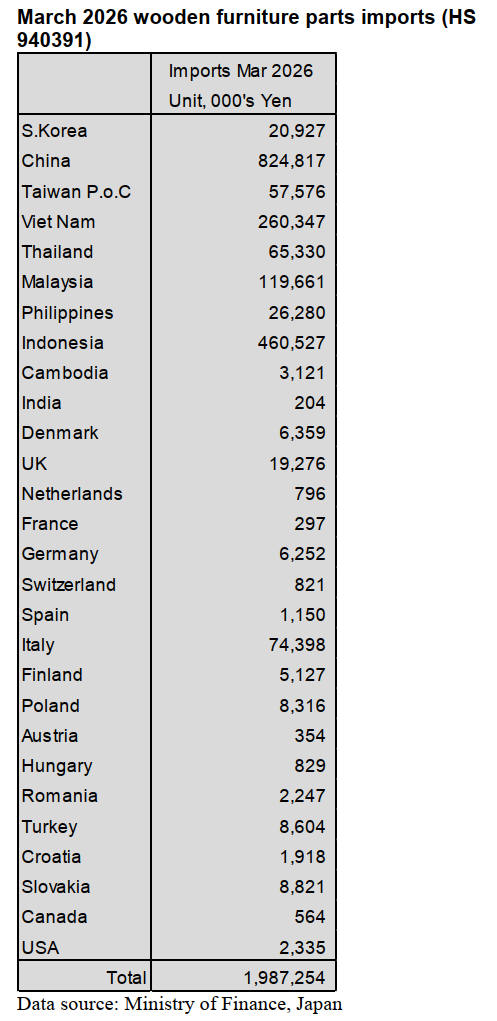
March2026 wooden furniture parts imports
(HS940391)
Shippers in China and three SE Asian countries, Viet
Nam, Indonesia and Malaysia accounted for 84% (90% in
February) of Japan’s imports of wooden furniture parts
(HS940391) in March 2026.
The main shipper of wooden furniture parts in March was
China at 42% (55% in February) followed by Indonesia at
23% (13% in February), Viet Nam 13% (16% in February)
and Malaysia 6% (6% in February). Of the non-Asian
suppliers arrivals of wooden furniture parts from Italy and
the UK were notable.
The value of arrivals of HS940391 in March was 16%
lower than in February 2026 and 10% lower than in March
2025.
Trade news from the Japan Lumber Reports (JLR)
The Japan Lumber Reports (JLR), a subscription trade
journal published every two weeks in English, is
generously allowing the ITTO Tropical Timber Market
Report to reproduce news on the Japanese market
precisely as it appears in the JLR. For the JLR report
please see: https://jfpj.jp/japan_lumber_reports/
Japan’s lumber exports to US rebound
Japan’s lumber export statistics for March show that
shipments of sawn timber to the United States reached
7,207 cbms, surpassing the 7,000-cubic-metere mark for
the first time since June 2021. Since 2018, this represents
the second-highest monthly volume, following the 7,260
cbms recorded in March 2021, when exports of Japanese
cedar fencing and decking materials were particularly
strong.
Amid a slowdown in shipments of Japanese cedar lumber
from China to the United States due to Trump-era tariffs,
exports from Japan to the U.S. have continued to rise since
last year.
Exports of sawn timber to the United States gained
attention particularly for Japanese cedar fencing and
decking materials, as supplies of Western Red Cedar,
traditionally used for exterior applications in the U.S
declined. Supported by rising prices and increased stay-at-
home demand during the COVID-19 pandemic, shipments
began climbing in the latter half of 2020. Annual volumes,
which had previously remained in the 20,000-cbm range,
exceeded 50,000 cbms in both 2020 and 2021.
However, exports retreated in 2023–24 to the 30,000–
40,000-cbm range, as U.S.-bound shipments of cedar
fencing and decking produced in China—using Japanese
cedar logs exported there— expanded, and inventories of
exterior-use lumber increased within the United States.
In 2025, however, exports rebounded to 58,246 cbms,
supported by the lighter tariff burden on shipments from
Japan compared with those from China, as well as by the
weaker yen.
During the January–March period of 2026, total log
exports reached 469,840 cbms, down 5% from a year
earlier. Shipments to China—which account for roughly
90% of the total—also edged down slightly but remained
at the second-highest level since 2018, following last year.
Meanwhile, cumulative sawn timber exports for January–
March totaled 47,540 cbms, up 12% from a year earlier.
While shipments to China fell 20% to 12,517 cbms,
exports to the United States surged 42% to 16,970 cbms,
driving overall growth. Looking ahead, rising prices in the
United States— partly influenced by instability in the
Middle East—could begin to affect the market.
National forests could resume market stabilising role
The Forestry Agency’s National Forest Management
Department has announced its major project plans for
fiscal 2026.
Despite noting significant uncertainties stemming from the
situation in the Middle East and fluctuations in timber
supply and demand, the agency set its targets at a 2% year-
on-year increase in standing timber sales and the same
volume as the previous year for log (processed timber)
sales.
Although crude oil prices remain volatile and shortages of
naphtha-related products persist, the agency noted that the
impact on the forestry sector is “not causing any
immediate disruption at this point,” according to the
Planning and Management Division.
However, drawing on the role that national forests played
in stabilising supply and demand during the COVID-19
pandemic and the so-called “wood shock,” the agency said
it will consider taking action depending on how conditions
develop.
Vietnam plywood supply tightens
Delays have begun to surface in shipments of BC-grade
Vietnamese plywood, a key product in the mainstream
packaging segment. In addition to labor shortages
following the Tet holiday, restrictions on adhesive supply
have further constrained production, resulting in shipment
delays of one to two weeks or longer in recent weeks.
With uncertainty over the outlook intensifying and
production costs continuing to rise, domestic sales prices
in Japan are all but certain to climb further.
Procurement of adhesives has emerged as the most
significant bottleneck for Vietnamese plywood and LVL
used in packaging applications. While supply has not been
completely cut off, factories are operating under strict
purchase caps, and inventory levels vary widely from plant
to plant, creating uneven production conditions across the
sector.
Benchmark domestic prices are currently around ¥1,200
per sheet for plywood (4×8 panels, delivered to packaging
plants) and roughly ¥56,000 per sheet for LVL on the
same basis. However, plywood prices are expected to rise
to nearly ¥1,300 per sheet by the end of May as cost
pressures intensify.
Looking ahead, LVL is expected to remain in a high price
range, with lead times lengthening somewhat but overall
supply continuing. Plywood, by contrast, is likely to face a
sharper deterioration in supply conditions, with lower-
priced grades such as BC-grade particularly vulnerable to
further declines in arrivals and worsening delivery delays.
South Sea logs and lumber
Demand for South Sea hardwood products and China-
made materials remains sluggish with deck-related items
also seeing slower movement since the start of the new
fiscal year. In producing regions, log harvesting has stayed
at low levels due to weather and other constraints, and
sawmill operations have not picked up.
Although Japan’s weak domestic demand has limited the
immediate impact, some market participants note concerns
about fuel shortages in Southeast Asia stemming from the
effective closure of the Strait of Hormuz, raising the risk
of prolonged disruption. In the glulam free-board market,
Indonesian merkus pine products continue to command
high prices due to ongoing harvesting restrictions.
Chinese red-pine products, which had previously
maintained stable selling prices, are now also seeing
upward revisions as local manufacturers move to raise
prices. In Japan, with overall market activity stagnant,
buyers remain cautious about placing new orders,
particularly for merkus pine products, whose export prices
were raised in February. Still, as high export prices persist,
domestic prices have begun to rise as well.
For South Sea hardwood logs, higher crude-oil prices have
pushed up harvesting costs for producers, slowing logging
activity.
While Japanese buyers are currently well supplied and
short-term effects are limited, prolonged reductions in
harvesting could eventually affect availability.
|


