|
1.
CENTRAL AND WEST AFRICA
Focus on compliance and infrastructure
Across Central and West Africa, two themes are becoming
increasingly important for the timber sector: stronger
regulatory oversight and major infrastructure investments.
Governments are pursuing tighter controls on taxation,
legality, and traceability, while simultaneously investing
in ports, logistics corridors, and industrial projects aimed
at increasing domestic value addition and improving
export competitiveness.
Gabon
The government has stepped up enforcement efforts across
the forestry sector targeting approximately 50 companies
that have reportedly failed to pay felling taxes over the
past three years.
Through a dedicated Forestry Task Force, authorities are
increasing scrutiny of tax compliance, concession
obligations and regulatory payments. The initiative is
expected to generate significant revenue for the
government while reinforcing oversight of forestry
operators.
In related news, Gabon’s Justice Department’s
Environment and Natural Resources Division (ENRD), in
partnership with the US Forest Service and the Ministry of
Water and Forests, the Sea and the Environment, hosted a
five-day multilateral workshop that included Cameroon
and Vietnam on combating trade in illegal.
The Principal Deputy Assistant Attorney Genera of
ENRD, Adam Gustafson, said “the United States has a
strong commercial interest in addressing illegal timber in
global supply chains and preventing illegal wood products
from entering the US market in violation of the Lacey Act.
He added, “illegally imported wood undercuts our
domestic producers”.
Kobe-Kobe deep-water port project moves forward
President Brice Clotaire Oligui Nguema visited the
construction site of the future Kobe-Kobe deep-water port
following the signing of a partnership agreement with
Africa Global Logistics. The project forms part of Gabon's
broader strategy to diversify its economy, improve
logistics infrastructure, strengthen regional trade links, and
support industrial development. Once completed, the port
could significantly improve export efficiency for timber,
mining products and other commodities while positioning
Gabon as a logistics hub for Central Africa.
See: https://maritimafrica.com/en/the-president-of-gabon-
launches-construction-works-on-the-kobe-kobe-deep-sea-port/
Cameroon, structure of the forestry sector remains
largely unchanged
Brice R. Mbodiam, writing forbusinessincameroon.com,
reports data from the National Institute of Statistics (INS)
in Cameroon show timber exports declined in 2025 but the
structure of the sector remains largely unchanged, with
sawnwood still leading shipments.
Reported data show that the country exported 762,007
tonnes of sawnwood in 2025, generating CFA157.6 billion
in revenue. While this segment again accounted for the
bulk of timber exports, both volumes and earnings were
down compared with the 2021–2024 period.
Over those four years, sawnwood exports ranged between
895,572 tonnes and 1.5 million tonnes, with revenues
between CFA170 billion and CFA212 billion. Weaker
demand in 2025 also weighed on log exports. Shipments
fell to 349,611 tonnes in 2025, down by more than
100,000 tonnes year on year. This marks the lowest level
in five years, compared with volumes ranging from
475,401 tonnes to about 919,000 tonnes between 2021 and
2024.
Logs continue to hold ground in international markets
despite increasingly restrictive policies. As part of a
regional plan to ban log exports by 2028 across Cemac
members (Cameroon, Congo, Gabon, Equatorial Guinea,
Chad and the Central African Republic). Cameroon has
stepped up efforts to promote local processing.
The government has relied heavily on taxation to shift
behavior. Between 2017 and 2024, export duties on logs
rose from 17.5% to 75% of the FOB value, amounting to
an overall increase of about 350%. Taxes on sawn wood
have also risen, though more gradually, with a 165%
increase between 2016 and 2023, according to the
Cameroon Timber Industry Association (GFBC).
At the same time the government has introduced
incentives to support domestic value addition. Since 2023,
equipment used for wood processing has been exempt
from import taxes. The government has also set aside two
industrial zones dedicated to wood processing.
See: https://www.businessincameroon.com/public-
management/2304-16072-cameroon-struggles-to-phase-out-log-
exports-despite-policy-pressure
Cameroon continues to face increasing pressure from
international markets and forest-governance initiatives to
strengthen legality verification, traceability systems, and
sustainable forest management practices. Compliance with
timber regulations is becoming increasingly important for
maintaining access to key export markets in Europe, Asia,
and North America.
Gabon’s Justice Department’s Environment and Natural
Resources Division (ENRD), in partnership with the US
Forest Service and the Ministry of Water and Forests, the
Sea and the Environment, hosted a five-day multilateral
workshop that included Cameroon and Vietnam on
combating trade in illegal.
The Principal Deputy Assistant Attorney Genera of
ENRD, Adam Gustafson, said “the United States has a
strong commercial interest in addressing illegal timber in
global supply chains and preventing illegal wood products
from entering the US market in violation of the Lacey Act.
He added, “illegally imported wood undercuts our
domestic producers”.
See: https://www.ipsnews.net/2026/06/billions-lost-as-secret-
financial-networks-fuel-forest-destruction-in-brazil-and-
cameroon/
Emerging youth-led initiatives in ecotourism, forest
conservation and sustainable forest enterprises
demonstrate a gradual diversification of Cameroon’s forest
economy. While timber remains important, growing
interest in alternative forest-based livelihoods highlights
broader opportunities within the country's forest sector.
See: https://www.myjoyonline.com/african-youth-emerge-as-
key-drivers-of-africas-forest-future-report-finds/
2.
GHANA
Exports slide in the first four months of 2026
According to data from the Timber Industry Development
Division (TIDD) of the Forestry Commission, Ghana’s
wood product export volume fell 14% to 66,572 cu.m,
with export value down by 20% to Eur29.34 million in the
first four-months of 2026, compared with the same period
in 2025.
The decline was due to low export volumes of all
products, except plywood, briquettes, air-dried and kiln-
dried boules and poles. The table below shows the
breakdown by product category.
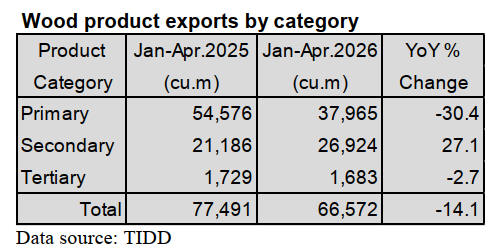
Exports of primary products fell over 30% to 37,965 cu.m.
during the first four months of 2026 compared to the same
period in the previous year. This has been attributed to the
sharp fall in exports of billets, kindling and kiln-dried
lumber to regional markets.
Exports of products which were categorised as secondary,
mainly from sawnwood, increased by 27% compared to
the previous period and this contributed to 26,924 cu.m.
However, exports of tertiary products, /mouldings and
dowels, fell 3% to 1,683 cu.m. in 2026 from 1,729 cu.m in
2025.
The decline in overall exports for the period was partially
compensated for by an increase in overseas plywood
exports which rose dramatically in the first four months to
7,099 cu.m., from 624 cu.m in the same period in 2025.
Export items were manufactured from mainly gmelina,
eucalyptus, citrodora and acacia and were shipped to the
USA, Cyprus, Netherlands, Poland and France.
Ghana Carrefour du Bois trade mission success
Ghana’s first timber trade mission to the Carrefour
International du Bois Exhibition (CIB) in France was a
success, enabling the sector to promote its products and its
recent start of FLEGT licensing, according to Dr. Richard
Gyimah of the Ghana Forestry Commission (GFC).
The mission, including a number of Ghanaian companies
as well as representatives of the GFC, was hosted at the
show in Nantes in early June on the stand of the
International Tropical Timber Technical Association
(ATIBT). Together with ATIBT, it also held a seminar
event on the value of FLEGT licensing. This was followed
by a business to business ‘matchmaking’ event. Ghana
also contributed to the ATIBT’s focus at the CIB on
promoting lesser-known tropical timber species.
Dr. Gyimah, who is Executive Director of the GFC’s
Timber Industry Development Division, said that the start
of FLEGT licencing in Ghana in October 2025 and its
subsequent promotion of timber and wood products as
‘Ghana Verified Timber’ were important on a number of
levels.
“It signifies that all timber from Ghana is legal and
traceable,” he said. “It verifies that it meets all the
requirements of the national laws of Ghana and that law
enforcement is being adhered to.”
“Unlike third party certification, which applies to private
companies individually, FLEGT brings all companies on
board, small-scale, medium- and large-scale. It embraces
all the ring of businesses and it provides a very good way
to promote trade as it sets a national standard which is
being adhered to by all companies within the supply
chain.”
While FLEGT Voluntary Partnership Agreements are
between supplier countries and the EU, FLEGT licensing
also has positives for Ghana’s timber trade internationally,
maintained Dr. Gyimah.
“The proof of legality under FLEGT, the chain of custody
and wood tracking systems we’ve established in Ghana
provide credibility on a global basis. Our exports to Asia,
or to the US, for example all meet the same standard of
[legality verification] as our timber exports to the EU. The
only difference is that they are not sold in those markets
with a FLEGT license,” he said. “So, the benefits of
FLEGT licensing to our timber industry are not only in the
EU but in all our export destinations.’
Ghana is also highlighting the social and environmental
obligations of timber companies under FLEGT.
“The level of social responsibility of companies to local
communities has been enhanced, so businesses are
supporting development of social infrastructure, helping
those communities establish schools and clinics and get
potable water,’ said Dr. Gyimah. “This is in addition to
the employment they provide in areas of timber
exploitation.”
He maintained that there are already signs that FLEGT
licensing is increasing interest in timber from Ghana.
“At least that is what we are hearing from buyers,” he said.
“We are also communicating with [EU member
countries’] competent authorities from whom we are
getting positive feedback and the European Commission is
praising what we are doing . In addition, we’ve had
engagement in Brussels with a lot of trade associations
where we were able to attest to the legality of our timber.”
Ghana is also confident its FLEGT achievements will help
its timber meet the requirements of the EU Deforestation
Regulation.
“Apart from meeting the EUDR legality requirement, we
can add components to FLEGT compliance on human
rights and it is also easier for us to meet the geolocation
requirements,” said Dr. Gyimah. “We took geolocation
into account in establishing our chain of custody system.
Currently Ghana’s FLEGT licenses do not exempt its
timber from further due diligence under the UK Timber
Regulation but there is hope this can change.
“We have been supported by the UK and it helped us with
the initial set up [of Ghana’s EU FLEGT VPA],” said Dr.
Ghiyama. “Now it is no longer in the EU, we need to
conclude a bilateral VPA between the UK and Ghana. We
are hopeful about this, but it has to come from the political
level.”
On the experience of attending the CIB, Dr. Gyimah said
the trade mission had been well received.
“ATIBT gave us the opportunity to showcase our products
and we got a lot of commendations from visitors,” he said.
“Also, the business-to-business event went well. Eight of
our companies made individual pitches, covering a wide
variety of different products . Then they had the
opportunity to talk to potential customers. Maybe we
should make the CIB a constant fixture for the Ghanaian
industry to promote our products, especially now, riding
on the back of FLEGT licensing.”
See - https://fc.gov.gh/
and
https://www.atibt.org/en/news/13878/ghana-at-cib-2026-a-
historic-first-for-the-flegt-era
350 companies involved in Ghana’s forest plantation
According to the Chief Executive Officer (CEO) of the
Forestry Commission of Ghana, Dr. Hugh C. A. Brown,
Ghana is currently engaging more than 350 private
companies and individuals in commercial forest plantation
development within the country's forest reserves.
Sharing data on the country’s forest plantation, Dr. Brown
said in 2025 over 31 million trees were planted across
23,600 hectares of degraded and deforested landscapes as
part of the country's broader "Tree for Life" initiative. He
mentioned that a recent survey of the plantations revealed
a success rate of 65% to 85% in the high forest zone and
40% to 78% in the Northern Savanna zone.
Touching on the achievements of the Tree for Life
Reforestation Initiative, the CEO said significant progress
had been made in restoring degraded landscapes across the
country over the years. He, however, expressed worry over
the persistent threat posed by deforestation and forest
degradation which quickly erode the gains with impunity.
Ghana’s forest cover, he stated, was estimated at 6.4
million hectares representing about 27 percent of the
country’s land area, with 1.02 million hectares classified
as closed-canopy forest and 5.37 million hectares as open
forest.
Dr. Brown therefore called for greater commitment from
all stakeholders to protect and restore the country's forest
resources.
See: https://www.myjoyonline.com/forestry-commission-ceo-
says-over-350-private-companies-involved-in-forest-plantations-
as-sector-generates-260-million/
Ghana signs £215 million pound growth partnership
A UK based forestry firm has announced a £85 million
reforestation fund for Ghana. The fund will finance carbon
credit projects, restore degraded land and create rural jobs.
This forms part of a three-year (2026 – 2028) Growth
Partnership worth up to £215 million signed in London
between Ghana and the United Kingdom targeting
investment and jobs across several priority sectors of the
economy. Ghana President John Dramani Mahama sealed
the agreement during his official visit to the UK where he
also opened the Ghana-UK Investment Summit 2026.
The British High Commissioner to Ghana, Christian Rogg,
said the deal would deliver visible benefits where people
can really see and feel its impact. The agreement coincides
with the fifth anniversary of the UK-Ghana Trade
Partnership Agreement. Bilateral trade between the two
countries has reached roughly £1.6 billion, up 12.5% since
2024, while the British International Investment (BII)
portfolio in Ghana stands at about £140 million.
See: https://www.newsghana.com.gh/ghana-uk-sign-215-million-
growth-partnership/
and
https://www.gov.uk/government/news/uk-ghana-growth-
partnership-to-drive-jobs-investment-and-skills
Ghana to promote responsible mining practices
The government of Ghana has taken a significant step
towards transforming the small-scale mining sector by
introducing the first Cooperative Mining Scheme (CMS).
The programme is designed to encourage mining that is
responsible, sustainable and led by local communities.
At the launch, the Minister for Lands and Natural
Resources, Emmanuel Armah-Kofi Buah, called on miners
and residents to adopt responsible mining practices to
ensure the long-term success of the initiative.
The Minister highlighted the government's five-pillar
strategy to curb illegal mining and promoting sustainable
resource management. The strategy includes strengthened
stakeholder engagement, enhanced law enforcement,
regulatory reforms, reclamation of degraded lands and
water bodies and the creation of alternative livelihood
opportunities.
The Minister said, these measures are critical for reducing
sediment levels in water bodies, reviving depleted forest
reserves and protecting the environment for future
generations.
The CMS marks a shift toward formalising small-scale
operations in the country while balancing economic
activity with environmental stewardship.
By placing communities at the center of the model, the
government hopes to create accountability, improve
livelihoods and reverse the ecological harm caused by
unregulated mining.
See: https://www.myjoyonline.com/lands-minister-armah-kofi-
buah-launches-responsible-cooperative-mining-initiative-for-
akyem-kotoku-in-eastern-region/
3. MALAYSIA
Stronger local currency
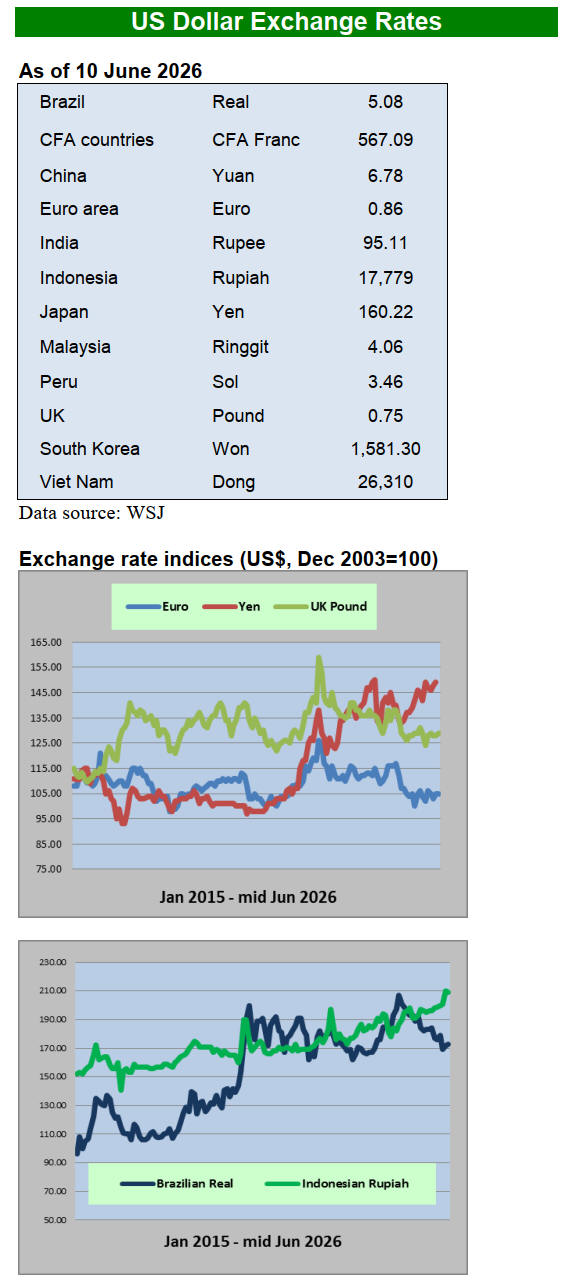
The Malaysian ringgit has appreciated against the US
dollar over the last six months driven by Malaysia’s strong
economic fundamentals, growing tech and commodity
exports and narrowing interest rate gaps with the US. The
ringgit is still among the top performing currencies in the
region. The Minister of Finance, Amir Hamzah Azizan,
said “More importantly for the ringgit, it is not just the
performance against the dollar but how it is positioned
against other currencies around the world and I think we
are much better.”
See: https://www.thestar.com.my/business/business-
news/2026/06/10/ringgit-remains-among-top-regional-
currencies-says-minister
MIFF 2026 Show Report
The Malaysian International Furniture Fair was held in
March covering 100,000 sq.m in Kuala Lumpur. It
generated an estimated US$1.24 billion in on-site sales.
There were a total of 643 exhibitors with 321 from
Malaysia. The international exhibitors came from China,
Hong Kong, Indonesia, Japan, Korea, Singapore, Sri
Lanka, Taiwan P.o.C, Turkey and Viet Nam.
See: https://miff.com.my/about-miff/miff-post-show-report/
Sarawak shift to planted forests
According to Sarawak Premier, Abang Johari Tun Openg,
Sarawak will gradually reduce its log and sawnwood
exports while encouraging downstream industries built on
planted forests as the State pushes to accelerate its
transition towards a green economy. The Premier cast the
export cut as a commitment to environmental
sustainability rather than a single policy instrument.
To revitalise the forestry sector the government is
encouraging downstream industries based on planted
forests to serve a dual purpose, producing biomass whilst
functioning as carbon sinks that feed the state’s renewable
energy and low-carbon agenda.
Behind that pivot lies a multi-year planted-forest and
restoration drive with Sarawak having planted more than
50 million trees by August 2025 and restoring some
137,000 hectares of degraded forest, around 69% of its
200,000-hectare target for 2030.
Because the strategy leans on forests as carbon assets as
much as timber stocks, Sarawak has already become the
first Malaysian State to implement forest carbon licences,
a step it ties to developing a green economy and a nature-
based carbon market. With market access increasingly tied
to proof of sustainability, more than 1.5 million hectares of
Sarawak forest now carry Forest Management
Certification, spanning 17 natural forest management units
and nine plantation units recognised under the PEFC
system.
See: https://woodcentral.com.au/sarawak-cut-timber-exports-
planted-
forests/?shem=dsdf,sharefoc,agadiscoversdl,,sh/x/discover/m1/4
Businesses request cap on government foreign
worker fees
Many industries in Malaysia are dependent on foreign
workers. In the context of Sarawak, its business
community has requested a cap be put on the fees
chargeable by the government per foreign worker.
The Foreign Workers Transformation Approach
(FWTA)’s current fee matrix poses an ‘immediate threat’
to Sarawak’s economic momentum a Sarawak Business
Federation (SBF) taskforce has warned. This comes after it
finalised a comprehensive industry evaluation concerning
the FWTA and its digital operating platform, the
Sarawakian and Non-Sarawakian Online Labour System
(Sansols) and extensive industry feedback.
Foreign workers play a vital part in Malaysia’s economy.
A total of 2.1 million active and legally registered foreign
workers were recorded working in Malaysia as of October
2025. The recruitment of foreign workers is currently
limited to six main formal sectors, namely construction,
services, plantations, agriculture, mining and quarrying
while only foreign domestic helpers are permitted in the
informal sector.
See:
http://theborneopost.pressreader.com/article/281522232751898
4.
INDONESIA
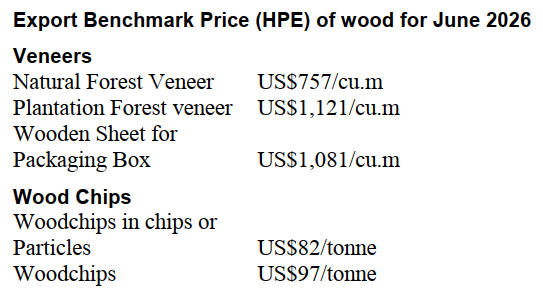
Processed Wood
Processed wood products which are leveled on all four
sides so that the surface becomes even and smooth with
the provisions of a cross-sectional area of 1,000 sq.m to
4,000 sq.m (ex 4407.11.00 to ex 4407.99.90)
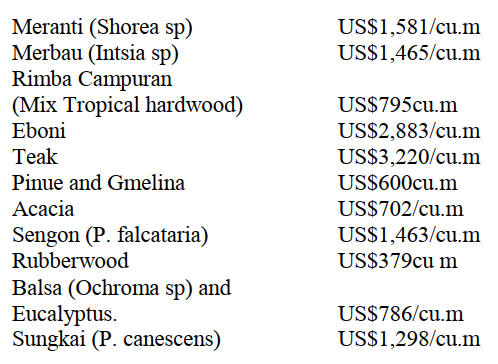
Processed wood products which are leveled on all four
sides so that the surface becomes even and smooth of
Merbau wood with the provisions of a cross-sectional area
of 4,000 sq.m to 10,000 sq.m (ex 4407.11.00 to ex
4407.99.90) = US$1,500/cu.m
See: https://jdih.kemendag.go.id/peraturan/keputusan-menteri-
perdagangan-republik-indonesia-nomor-1414-tahun-2026-
tentang-harga-patokan-ekspor-dan-harga-referensi-dtas-produk-
pertanian-dan-kehutanan-yang-dikenakan-bea-keluar-dan-tarif-
layanan-badan-layanan-umum
Plywood Industry is facing turbulent international
trade
APKINDO has said Indonesia’s plywood sector is facing
one of its most challenging periods in the last decade with
production and exports declining significantly. National
plywood production reached 971,000 cubic metres for the
year to April 2026, down 22% from the same period in
2025 while exports fell from US$441 million to US$324
million in the first quarter.
Reduced natural forest log supply, which declined by
about 20% year-on-year, has constrained production
leading to a projected annual output of only 2.8 million
cubic metres, the lowest level in ten years.
Export volumes in the first quarter dropped nearly 30%
year-on-year to 670,000 cubic metres with Asia remaining
the largest destination, accounting for 57% of shipments.
However, Europe emerged as a bright spot, as exports to
the EU increased 34% in volume and 21% in value, while
exports to the United Kingdom rose 38% and 45%,
respectively.
This growth was largely driven by rising demand for film
face plywood and combi plywood as European buyers
shifted away from Chinese suppliers. Blockboard also
remained an important export product, contributing 22%
of Indonesia’s wood panel exports.
In contrast, exports to the United States declined sharply
following the implementation of anti-dumping and
countervailing duties with volumes and values falling by
more than half. Imports by Canada and Mexico helped
offset some of these losses, recording strong import
growth and emerging as important alternative markets.
Japan remained the most stable destination, maintaining
steady demand and accepting higher prices from
Indonesian suppliers.
Geopolitical tensions severely disrupted exports to Middle
East countries causing significant declines in both volume
and value. Nevertheless, industry stakeholders remain
optimistic that future reconstruction efforts in the region
could generate substantial demand for plywood,
positioning Indonesia to benefit from a potential market
recovery.
See: https://apkindo.org/berita/detail/indonesias-plywood-
industry-standing-firm-amid-global-turbulence-navigating-
waves-international-trade
Furniture sector digitalisation to boost export
competitiveness
Indonesia’s Ministry of Industry is promoting
digitalisation in the furniture sector as part of efforts to
improve productivity, efficiency and export
competitiveness. Speaking at Indo Wood Expo 2026,
Industry 4.0 Transformation Expert, Andi Rizaldi, said
digital technologies can help streamline production
processes, reduce defects and increase output.
The ministry also welcomed a partnership between the
Indonesian Furniture Industry and Craft Association
(HIMKI) and digitalisation provider Labamu to accelerate
technology adoption.
HIMKI Chairman Abdul Sobur emphasised that adopting
advanced manufacturing technologies is essential for
improving efficiency and strengthening Indonesia’s
position in global furniture markets. While Indonesian
furniture is recognised for its design strengths, higher
production costs remain a challenge compared to
competing countries. Increased use of industrial machinery
and digital solutions, he said, can significantly improve
productivity, shorten production times and lower
manufacturing costs.
See: https://www.antaranews.com/berita/5593968/kemenperin-
dukung-digitalisasi-furnitur-untuk-perkuat-ekspor
and
https://www.antaranews.com/berita/5594553/himki-dorong-
inovasi-teknologi-perkuat-daya-saing-industri-kerajinan
Strong dollar – only short term relief for furniture
exporters
Indonesia’s furniture and handicraft industry views the
recent strengthening of the U.S. dollar as only a temporary
advantage rather than a long-term solution for export
growth.
According to Indonesian Furniture Industry and Craft
Association (HIMKI) Chairman, Abdul Sobur, while
exporters may benefit from earnings in US dollars some
production costs remain in rupiah such that any exchange
rate gains are offset by higher costs for imported raw
materials, machinery, components, finishing products and
shipping.
As a result, the positive impact of exchange rate
movements does not automatically translate into
significantly higher profits for manufacturers.
Sobur emphasised that the industry’s future depends more
on sustainable global demand and stronger
competitiveness than on currency fluctuations. He warned
that a stronger US dollar, driven by global economic
uncertainty or high interest rates, could reduce furniture
consumption in export markets as consumers tend to
postpone non-essential purchases.
To ensure long-term growth, Indonesia’s furniture sector
needs improvements in productivity, efficiency, design
innovation, workforce quality and consistent government
policies.
He stressed that exchange rate advantages should be
regarded as a bonus rather than a core strategy for
maintaining international competitiveness.
See:
https://money.kompas.com/read/2026/05/27/151314726/penguat
an-dollar-as-belum-cukup-dongkrak-ekspor-mebel-pelaku-usaha-
minta?page=all#page2.
Minister pushes multi-business forestry to support
productive forests
Indonesia's Forestry Minister, Raja Juli Antoni, is
promoting the implementation of Multi-Business Forestry
(MUK) as a strategy to create productive, sustainable and
investment-friendly forest management. The initiative is
designed to integrate ecological, economic, social and
market interests while addressing challenges related to the
green economy, biodiversity conservation, food security
and the welfare of forest-dependent communities.
To accelerate implementation the Ministry of Forestry has
established an MUK Task Force to strengthen data
support, coordination and technical follow-up, ensuring
that the programme can be carried out more effectively.
In related news, Indonesia’s Deputy Minister of Forestry,
Rohmat Marzuki, stressed that improving the quality of
social forestry management is key to strengthening the
national economy while maintaining forest sustainability.
He said the programme’s success should no longer be
judged solely by the expansion of permit areas but by
better land management, wider adoption of agroforestry
practices, stronger community institutions, improved
market access and greater economic benefits for local
communities.
To support these objectives, the Ministry of Forestry
continues to implement the Agroforestry Facilitation
Program for Food and Energy (FAPE), which provides
seedlings and technical assistance to forest farmer groups.
The government is seeking to strengthen social forestry
programmes by integrating them with broader social
protection systems to improve welfare and economic
security for millions of people living in and around forest
areas.
Forestry Minister Raja Juli Antoni emphasised the need
for stronger coordination among the Ministry of Social
Affairs, regional governments, National Health Insurance
(NHI) or BPJS Kesehatan, and Workers Social Security
Agency or BPJS Ketenagakerjaan to ensure forest-
dependent communities receive the best support. The
minister said social forest policies should place greater
emphasis on improving living standards, welfare and
social protection for forest communities.
See: https://forestinsights.id/multiusaha-kehutanan-
diproyeksikan-serap-25-juta-ton-emisi-hingga-2045/
and
https://www.antaranews.com/berita/5600168/wamenhut-
peningkatan-kualitas-perhutanan-sosial-pacu-roda-ekonomi
and
https://en.antaranews.com/news/417748/indonesian-govt-pushes-
social-forestry-into-welfare-safety-net
Forestry investment opportunities for carbon trading
Indonesia’s Ministry of Forestry has highlighted
expanding investment opportunities in the forestry sector’s
carbon trading market, supported by new regulations
aimed at aligning with international standards.
Principal Advisor to the Minister of Forestry Edo
Mahendra said the country has entered a new phase of
carbon market development with Minister of Forestry
Regulation No. 6/2026 providing a clear framework to
accelerate carbon trading through simpler and more
transparent business processes.
The regulation also opens access to various carbon
economic value mechanisms, including the nesting
approach, which are designed to ensure environmental
integrity, avoid double counting, and enhance investor
confidence.
See: https://rri.co.id/en/national/2441118/govt-strengthens-
regulatory-support-for-forest-carbon-investment
Local wisdom key to SFM in Papua
Indonesia’s Ministry of Forestry has emphasised that local
wisdom and social values must be at the centre of
sustainable forest management efforts in Papua,
particularly in Highland Papua. Advisor to the Minister of
Forestry for Climate Change, Prof. Haruni Krisnawati,
stated that integrating indigenous knowledge and
community-based approaches are essential to achieving
conservation and development goals while ensuring the
long-term protection of the region’s forests.
The ministry also highlighted the importance of aligning
sustainable forest management in Papua with global
climate initiatives. Krisnawati noted that nearly 80% of
Highland Papua’s forest areas remain intact and in very
good condition, making the region a critical stronghold for
Indonesia’s tropical forests.
See: https://en.antaranews.com/news/417501/papuas-local-
wisdom-key-to-sustainable-forest-management-ministry
5.
MYANMAR
6.
INDIA
Monsoon - a key driver of the country’s
economy
India’s southwest monsoon is a key driver of the country’s
economy. The monsoon delivers nearly 70% of India's
rainfall and supports the farming sector, which contributes
about 18% to the economy and provides livelihoods to
nearly half the population.
Its impact goes beyond agriculture. The monsoon
influences rural incomes, food prices and overall
economic activity. Even though irrigation, supply chains
and policy support have improved over time the June to
September rains still play a major role in shaping
outcomes across the country.
Concerns over harvests, food prices and economic growth
were heightened in May when the Meteorological
Department warned that an El Nino weakened monsoon in
2026 could deliver the driest season the country has seen
in 11 years.
See: https://www.kotakmf.com/Information/blogs/monsoon-
india-economic-impact
and
https://www.aljazeera.com/news/2026/6/4/monsoon-rain-
reaches-kerala-3-days-late-but-on-time-to-save-indian-harvests
US blockade of the Strait of Hormuz a major challenge
The Institute of South Asian Studies (ISAS) has
commented that the US blockade of the Strait of Hormuz
has created an economic challenge for India. The adverse
impact on India’s energy security, particularly for
petroleum and LPG, is hurting most manufacturing many
sectors with lay-off being reported. The government has
taken steps for energy supply diversification and fiscal
measures to minimise price increases but the pressure on
the rupee and foreign reserves continue.
See: https://www.isas.nus.edu.sg/papers/the-united-states-iran-
conflict-economic-implications-on-india/
Middle East conflict has impacted plywood market
structure
The Middle East conflict has allowed ‘organised’ plywood
manufacturers to gain market share, said the CFO of a
major plywood manufacturer. The ongoing conflict has
unexpectedly benefited India's organised plywood sector
by pressuring smaller, unorganised manufacturers. The
large ‘organised’ industries have captured market share
due to increased raw material costs and tightened credit
which has squeezed the finances of small operators.
See: https://lnkd.in/gXHz5a6h
Rupee at record low
The rupee weakened to a record low of 95.8 against the
US dollar early June as persistent external pressures kept
sentiment subdued. The domestic currency gained slightly
to 95.5 after measures to curb the current account deficit
through higher duties on gold and silver imports were
introduced .
The domestic press says, in the short term this
measure
can help reduce the import bill since gold accounts for
nearly 9-10% of India’s total import bill.
The rupee has depreciated over 6% in 2026 making it the
worst-performing currency in Asia and has fallen more
than 5% since the onset of the West Asia conflict.
High crude oil prices have strained the current account and
led to downward revisions in growth forecast while
inflation projections have moved higher adding to
concerns over macroeconomic stability. The Times of
India says the currency is expected to weak further with
projections nearing 97/per US Dollar by year-end.
See: https://timesofindia.indiatimes.com/business/india-
business/rupee-at-record-low-of-95-8/-worst-performer-in-asia-
this-year/articleshow/131080543.cms
Agarwood exports to Gulf countries
An Indian company has been successful with exports of
agarwood chips to Saudi Arabia and the UAE valued at
Rs2.35 crore (Approximately US$0.25 million)
This is a milestone for the state’s agro-forest economy
opening opportunities for farmers and businesses as a
result of the Assam Agarwood Promotion Policy.
See: https://economictimes.indiatimes.com/news/india/assam-
makes-first-legal-agarwood-export-to-gulf-eyes-rs-50000-crore-
potential/articleshow/131070995.cms?from=mdr
Heat wave alerts across India
The India Meteorological Department issued early alerts
for above-normal maximum temperatures across most of
India. A transition from La Niña to El Niño conditions is
expected by mid-2026. Historically, El Niño events in
India are linked to intense heatwaves and potential
monsoon irregularities.
2026 is forecast to be the fourth consecutive year with
average global temperatures rising by at least above pre-
industrial levels. A transition from La Niña to El Niño
conditions is expected by mid-2026. Historically, El Niño
events in India are linked to intense heatwaves and
potential monsoon irregularities.
2026 is forecast to be the fourth consecutive year with
average global temperatures rising by at least above pre-
industrial levels.
See: https://www.news18.com/explainers/will-summer-of-2026-
be-hotter-than-2024-when-temperatures-crossed-50c-phones-acs-
caught-fire-ws-l-9953246.html
7.
VIETNAM
Wood and wood product (W&WP) trade
highlights
The Viet Nam Customs Office has reported W&WP
exports in May 2026 reached US$1.5 billion, down 4.5%
compared to April 2026 but up 6% compared to May
2025. Of the total, WP exports alone amounted to
US$915.3 million, down 9% compared to April 2026 and
down 9% compared to May 2025.
In the first 5 months of 2026 W&WP exports totalled
US$7.1 billion, up 4% over the same period in 2025 of
which WP exports accounted for US$4.5 billion, down 4%
over the same period in 2025.
Viet Nam’s W&WP exports to the US in May 2026 earned
US$780 million, down 1% compared to April 2026 and
down 8% compared to May 2025. In the first 5 months of
2026 W&WP exports to the US stood at US$3.5 billion,
down 7% over the same period in 2025.
Viet Nam's imports of raw wood (logs and sawwood) in
April 2026 were at 638,900 cu.m, worth US$217.4
million, up 6% in volume and 6% in value compared to
March 2026 and up 22% in volume and 31% in value
compared to April 2025. In the first 4 months of 2026,
Viet Nam's imports of raw wood reached 2.24 million
cu.m, worth US$760.1 million, up 14% in volume and
23% in value over the same period in 2025.
Imports of raw wood from Europe in May 2026 were
estimated at 93,000 cu.m at a value of US$28.36 million,
up 11% in volume and 10% in value compared to April
2026 showing an increase of 22% in volume and 21% in
value over the same period in 2025. In the first 5 months
of 2026, imports of raw wood from Europe amounted to
387,380 cu.m at a value of US$118.16 million, up 18% in
volume and 19% in value over the same period in 2025.
Viet Nam's NTFP exports in April 2026 fetched US$80.21
million, down 4% compared to March 2026 but still up 1%
compared to April 2025. In the first 4 months of 2026,
NTFP exports totalled US$319 million, up 11% over the
same period in 2025.
Viet Nam to complete forest database by 2026 to adapt
to EU’s deforestation rules
Viet Nam aims to complete provincial forest boundary
databases and maps before the end of this year in a move
seen as critical to helping the timber industry adapt to the
European Union’s anti-deforestation rules and maintain
exports.
The goal is set out in an action plan issued by the
Forestry
and Forest Protection Department under the Ministry of
Agriculture and Environment on adapting to the EU
Deforestation Regulation (EUDR), which bans products
linked to deforestation or forest degradation from entering
the block.
A forest database is considered a critical technical
foundation for meeting EUDR requirements on
traceability and spatial data transparency, while
accelerating the digital transformation of forest
management in line with international practices, with the
overall objective of fully complying with the EUDR,
sustaining exports and promoting sustainable forestry
development and biodiversity conservation.
Under the plan, all localities must build and
publish forest
boundary databases and maps by 31 December.
They are also required to identify and disclose
coffee,
rubber and timber production areas at risk of deforestation
or forest degradation.
An official EUDR compliance guideline for the timber
industry is set to be issued by 31 December. In addition,
the plan targets improvements to legal frameworks on
traceability, sustainable production, circular and green
economy, and aims to strengthen the capacity of
regulators, businesses and stakeholders in implementing
the EUDR.
To achieve these goals the plan outlines six
priority tasks,
including legal reforms, technical infrastructure upgrades,
enforcement capacity building, stronger monitoring and
expanded international cooperation.
In technical infrastructure, the plan prioritises
building a
unified national forest database and mapping system,
developing EU-aligned monitoring indicators, operating
an integrated digital platform linking EUDR traceability
data with planting area codes and sustainable forest
management certificates and applying new spatial data
technologies.
Viet Nam will also engage with the EU and its member
states on risk assessment methods and monitoring
indicators, work with the EU’s Joint Research Centre to
align forest mapping databases and seek mutual
recognition mechanisms for legal timber certification.
According to Trương Tất Đơ of the Forestry and
Forest
Protection Department, compliance with EU requirements
will help Vietnamese firms access other high-end markets
as environmental and supply chain transparency standards
tighten globally.
Đơ said the EUDR covers the entire supply chain from
harvesting and transport to processing and export, adding
that if violations occur at any stage or if deforestation took
place after December 31, 2020 the product may be deemed
non-compliant.
In May 2025, the European Commission classified Viet
Nam as a low-risk country, meaning only about 1% of
shipments or exporters are subject to checks. However,
officials warned that this status depends on strict
compliance and reliable, transparent data systems.
See: https://vietnamnews.vn/environment/1765786/viet-nam-to-
complete-forest-database-by-2026-to-adapt-to-eu-s-
deforestation-rules.html
Furniture manufacturers embrace melamine plywood
Viet Nam Furniture manufacturers are increasingly
choosing melamine plywood to reduce production costs,
improve efficiency and maintain consistent product
quality. While veneer coated plywood remains popular
for premium furniture, melamine plywood has become a
preferred solution for commercial and large-scale
manufacturing applications.
In the past, melamine surfaces often looked
artificial
and lacked the visual appeal of real wood. Advances in
decorative surface technology have changed that
perception.
Modern melamine plywood can feature highly realistic
woodgrain designs, textured finishes, matte surfaces
and synchronised grain effects that closely mimic
natural timber.
Despite the growing popularity of melamine plywood,
veneer plywood continues to play an important role in
the furniture industry:
Luxury Furniture
Natural wood veneer provides depth, character and
authenticity that many premium customers appreciate.
Hospitality Projects
Luxury hotels and executive spaces often favor
genuine
wood surfaces to create a more sophisticated and
upscale atmosphere.
Architectural Interiors
Architects and designers frequently specify veneer
plywood when craftsmanship, natural materials and
unique wood grain patterns are central to the design
concept. In these applications veneered plywood
remains difficult to replace.
Melamine plywood helps furniture manufacturers
reduce costs, speed up production and maintain
consistent quality. While veneer plywood remains the
preferred choice for premium projects, melamine
plywood continues to gain popularity in commercial
and large-scale furniture manufacturing.
See: https://ttplywood.com/why-furniture-manufacturers-are-
switching-to-melamine-plywood
Viet Nam launching new regulations for forest carbon
projects
Viet Nam’s rules say that revenue from forest-based
carbon credits will be prioritised for forest protection and
development as well as community livelihoods. Viet Nam
has been introducing new regulatory frameworks on
carbon markets ahead of plans to launch a domestic carbon
exchange at the end of 2026 with the latest focused on
forest carbon services.
Viet Nam has passed the country’s first set of rules
governing forest carbon sequestration and storage
services, as it prepares to launch its carbon exchange later
this year. Published on 21 May, Decree No. 180/2026/ND-
CP mandates “openness, transparency and accountability”
in the provision and use of forest carbon services, state-run
publication.
See: https://www.eco-business.com/news/vietnam-indonesia-
launch-new-regulations-for-forest-carbon-projects/
Recent wood product export trends
Viet Nam’s wood and wood products industry is facing
severe legal and trade protection challenges, yet it remains
resilient thanks to market diversification. The United
States is still Viet Nam’s largest wood export market but
the impact of the US administration’s tariff policies has
forced Viet Nam to accelerate the diversification of its
markets with Europe becoming a key direction for its
strategic shift.
Exporters are also actively expanding markets in Japan,
China, South Korea and the Middle East. To cushion
against potential US tariff hikes, approximately 45 new
markets have been targeted.
Japan has shown particularly strong growth, becoming
Viet Nam’s second largest destination, with exports rising
by more than 23% over the past year. China remains the
third-largest market, supported by growing demand for
Vietnamese wood chips, with imports increasing by about
3.5% in recent reporting periods.
Since 2026, China’s imports of Vietnamese timber
have
continued to rise. According to Customs data, cumulative
timber imports in the first four months of 2026 reached
225,000 cubic metres, up 244% year-on-year and the value
surged by a factor of 4 to US$154 million and the average
import price rose 54% year-on-year. Monthly year-on-year
growth rates have all exceeded 160%. Canada, Spain and
other countries have emerged as new growth points.
According to market analysis this success stems not
only
from expanding domestic demand but more significantly
from substantial trade diversion effects.
Amid ongoing China-US trade frictions and high US
timber tariffs last year some US raw logs were processed
or re-exported via Viet Nam to enter the Chinese market in
order to avoid tariff barriers and reduce overall costs.
Notably, although China-US raw log trade channels
have
resumed, the cost of direct US timber procurement
remains high.
China’simport data for the first four months of this
year
show that prices of high-value species such as ash and oak
imported from Viet Nam are even lower than those of the
same timber sourced directly from the US, highlighting
the cost competitiveness of the “Viet Nam transit” model.
Industry insiders note that while the China-US
timber
trade has resumed it has not yet returned to its previous
scale and efficiency. The current situation reflects more
market-driven adjustments than a full restoration of trade
relations.
See: https://www.sumecbuildingmaterial.com/news/vietnams-
recent-wood-export/
Export decline narrows as market conditions improve
The United States remained Viet Nam’s largest export
destination for wood and wood products during the first
five months of 2026. Although exports continued to
decline compared to the previous year, recent data indicate
that market conditions are gradually stabilizing and may
be entering an early recovery phase.
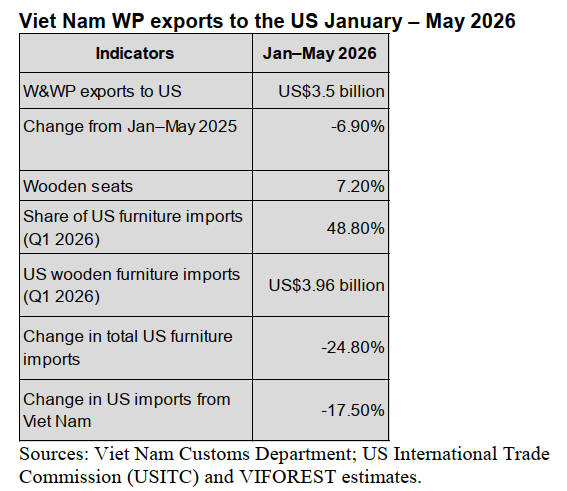
According to estimates based on Viet Nam Customs data,
exports of wood and wood products to the US reached
approximately US$780 million in May 2026, down 1.0%
from April 2026 and 8.4% lower than in May 2025.
Cumulative exports during January–May 2026 are
estimated at US$3.5 billion, representing a decline of 6.9%
compared to the same period of 2025. Nevertheless, the
pace of contraction has narrowed significantly over recent
months. The improvement coincides with the onset of the
US spring–summer construction and home improvement
season, traditionally the strongest period for furniture
consumption and residential renovation activities.
After more than a year of adjustment caused by elevated
mortgage rates and subdued housing activity, the market
appears to be approaching a more stable phase.
Home Renovation Spending Emerges as the Main
Growth Driver
Viet Nam’s export performance continues to be strongly
influenced by developments in the US housing market.
High mortgage rates have weighed on residential property
transactions and new housing construction since 2024. As
affordability challenges persist, many American
households have postponed home purchases and instead
invested in maintaining, upgrading or selectively
renovating existing properties.
In April 2026, US spending on residential renovation
and
remodeling increased by 0.4% month-on-month and 7.5%
year-on-year. This trend has created a new demand pattern
within the furniture market.
Rather than purchasing complete furniture packages
associated with newly constructed homes, consumers
increasingly favor replacing individual items such as
chairs, tables, shelving units and doors. Consequently,
replacement-oriented furniture categories have
outperformed products tied to new housing construction.
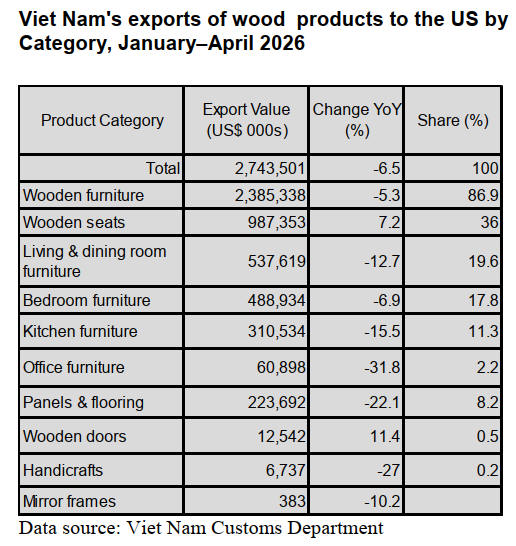
Among Viet Nam’s exports, wooden-frame chairs have
been the standout performer. During January–April 2026,
exports reached nearly US$987 million, increasing by
7.2% year-on-year and raising their share of Viet Nam’s
total wood exports to the US from 31.4% to 36.0%.
Wooden doors also posted positive growth of 11.4%,
reflecting demand generated by home renovation
activities.
The performance of these products highlights an
important
shift in the structure of US furniture consumption and
underscores the adaptability of Viet Namese
manufacturers to changing market conditions.
Viet Nam expands market share in the US
The most notable development so far in 2026 has been
Viet Nam’s continued expansion of market share in the
United States.
According to data from the US International Trade
Commission (USITC), total US imports of wooden
furniture reached US$3.96 billion during the first quarter
of 2026, representing a decline of 25% compared with the
same period of 2025.
Against this backdrop US imports from Viet Nam
declined
by only 18%, outperforming the market average.
Consequently, Viet Nam’s share of US wooden furniture
imports increased from 44% in Q1 2025 to 49% in Q1
2026, approaching half of total US imports. This
represents a remarkable achievement given the
challenging market environment.
By contrast, imports from China declined by 54%,
reducing China's market share from 14% to only 8%.
Other major suppliers also experienced substantial
declines, including Canada (-20%), Mexico (-32%) and
Malaysia (-34%).
The figures suggest that Viet Nam has successfully
absorbed a significant portion of market share relinquished
by competing suppliers, particularly China. The trend also
reflects the continuing diversification of global furniture
supply chains as international buyers seek alternatives to
traditional sourcing locations.
Premium market segments offer new opportunities
An emerging feature of the US housing market is growing
regional divergence. While some housing markets in the
South have softened, higher-income metropolitan regions
along the West Coast and the Northeast Corridor continue
to perform relatively well. Rising home values in major
urban centers and strong stock market performance have
helped support consumer spending among affluent
households.
These consumers are generally less sensitive to high
interest rates and continue to purchase premium furniture
and design-oriented home furnishings.
For Vietnamese manufacturers, this trend presents an
opportunity to move further up the value chain by
expanding into higher-value furniture segments that
emphasise design, quality and sustainability. Despite
encouraging signs risks remain significant.
Viet Nam's rapidly expanding market share is likely
to
attract greater scrutiny from US trade authorities. As Viet
Nam approaches a 50% share of US wooden furniture
imports, issues related to origin verification, anti-
circumvention measures and trade compliance are
expected to receive increasing attention.
Maintaining transparent supply chains and ensuring
full
compliance with legality and traceability requirements will
therefore remain critical for exporters.
The use of legally sourced timber and
internationally
recognised certification systems will become increasingly
important in safeguarding market access.
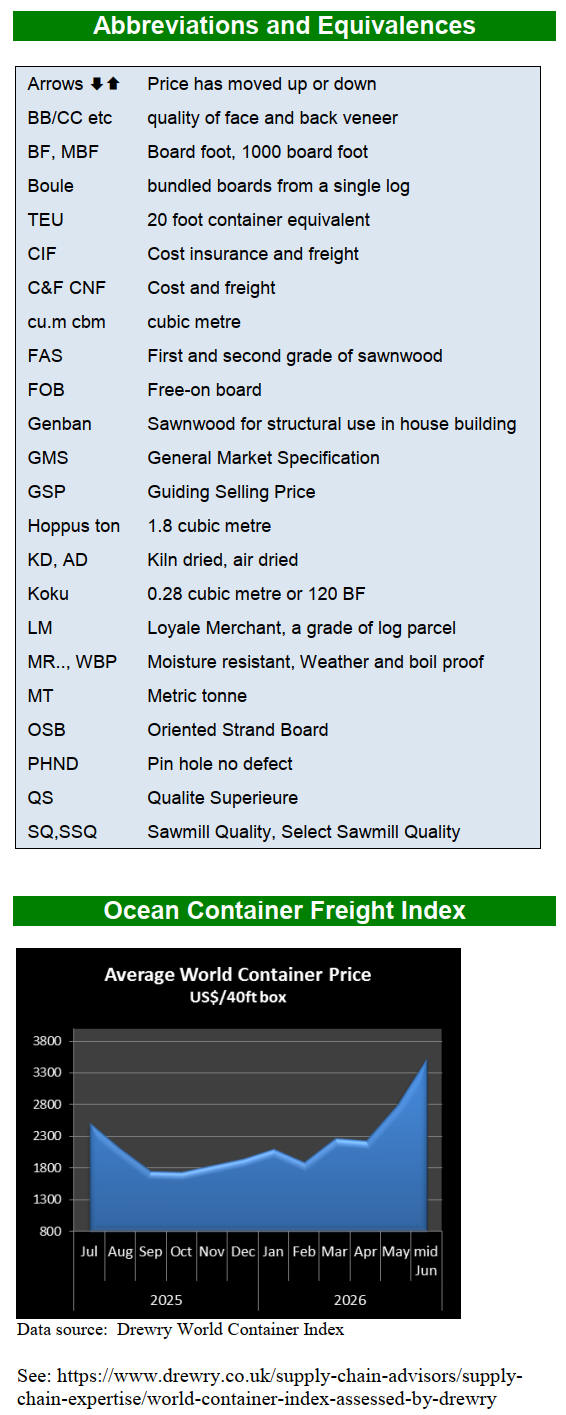
Meanwhile, geopolitical tensions and uncertainty in global
shipping markets continue to pose risks to logistics costs
and supply chain stability. Any significant increase in
freight rates could directly affect profitability, particularly
for exporters operating under long-term contracts.
Although Viet Nam’s exports of wood and wood
products
to the United States remain below levels during the first
five months of 2025 several indicators suggest that market
conditions are gradually improving.
Demand generated by home renovation activities is
providing important support to the market, while Viet
Nam continues to strengthen its competitive position
relative to other major suppliers. The strong performance
of wooden-frame chairs and the continued increase in Viet
Nam’s market share demonstrate the industry's ability to
adapt to evolving consumer preferences.
Provided inflationary pressures continue to moderate
and
housing activity improves gradually during the second half
of 2026, Viet Nam’s wood industry has a solid basis for
expecting stronger export performance in the months
ahead.
While challenges related to trade policy, compliance
requirements and logistics costs remain, Viet Nam enters
the second half of 2026 with a stronger competitive
position than many of its international competitors and
with growing opportunities in both replacement-oriented
and higher-value furniture segments.
The most important story behind Viet Nam’s wood
exports to the United States in 2026 is not the 7% decline
in export value, but the fact that Viet Nam has increased
its share of US wooden furniture imports to nearly 50%
during a period when the overall US market contracted by
almost 25%. This underscores the country's growing
strategic importance in global furniture supply chains and
its ability to gain ground even under adverse market
conditions.
Source: VIFOREST
and
https://www.vietnam-briefing.com/news/vietnams-wood-
industry-2026-challenges-new-opportunities.html/
8. BRAZIL
Leadership in the bioeconomy through
purpose-grown
forests
The State of Minas Gerais has emerged as a major
reference in the green economy through the concept of
“Planned forests” (florestas pensadas) promoted by the
Minas Gerais Forest Industry Association (AMIF).
Minas Gerais has approximately 2.3 million hectares of
planted forests representing 22% of Brazil’s planted forest
area. In addition, the sector conserves more than 1.3
million hectares of native vegetation. It is reported that the
forest-based sector has generate around 115,000 direct and
indirect jobs and benefits approximately 615,000 people
through social and environmental initiatives and projects.
In addition to supplying renewable raw materials for
industries, planted forests play an important role in climate
change mitigation by acting as carbon sinks and
contributing to the restoration of degraded lands.
The sector also stands out for its intensive use of
science,
technology and innovation, supported by highly efficient
production systems adapted to diverse environmental
conditions.
With high productivity, extensive areas suitable for
sustainable expansion, a well-established industrial base
and expertise in producing renewable inputs, the State
seeks to transform its planted forests as a strategic asset
for job creation, environmental conservation and low-
carbon economic development.
See: https://maisfloresta.com.br/florestas-pensadas-colocam-
minas-gerais-no-centro-da-economia-verde/
Challenges to inclusion of commercial tree species in
Invasive Species list
The proposed revision of the Brazil’s national list of’
Priority Invasive Exotic Species’ has generated strong
concern within Brazil´s forest sector.
The main issue is the possible inclusion of tree species
widely used in Brazilian forestry such as pine, eucalyptus
and acacia in the list being prepared by the Ministry of the
Environment and the National Biodiversity Commission
(CONABIO).
According to industry representatives, such a measure
could create legal uncertainty, discourage investments and
negatively affect strategic production chains that are
important to the Brazilian economy.
The Paraná Association of Forest-Based Companies
(APRE Florestas) argued that any regulatory decisions
should be based on scientific, economic and social criteria,
emphasising the importance of these species for job
creation, income generation and the supply of renewable
raw materials to a wide range of industrial sectors.
APRE also noted that the possible spread of these species
is already addressed through continuous monitoring,
responsible forest management practices and rigorous
environmental control protocols.
During the hearing, lawmakers, researchers and industry
representatives highlighted the potential impacts of the
proposal on forestry, aquaculture and fruit production, as
well as on public policies and private investments.
Studies presented by the Institute for Forest Research and
Studies (IPEF) indicated that ecological factors and forest
management practices help limit the unwanted spread of
these species.
As an alternative, APRE Florestas advocates targeted
monitoring and management measures for species such as
Pinus taeda and Pinus elliottii in environmentally sensitive
areas rather than their broad classification as invasive
species throughout the entire country.
See: https://apreflorestas.com.br/noticias/setor-florestal-reage-a-
proposta-de-lista-de-especies-invasoras-em-audiencia-em-
brasilia-e-alerta-para-inseguranca-juridica/
Global timber markets: trends and opportunities
Global timber demand is influenced by a combination of
economic, logistical, environmental, regulatory and
geopolitical factors reflecting, not only demand from the
construction sector, but also from sectors such as wood
panels, biomass, packaging and high value-added
products.
The growing importance of the bioeconomy and
renewable materials has strengthened the role of timber in
decarbonisation strategies. At the same time, requirements
related to certification, traceability, environmental
compliance, land tenure regularity and socio-
environmental standards are becoming prerequisites for
access to international markets.
In this context, Brazil claims a significant competitive
advantages including high forest productivity in planted
forests, extensive industrial expertise and a diversified
forest-based value chain. However, challenges related to
logistics infrastructure, high capital costs and regulatory
uncertainty continue to constrain part of this potential.
The main opportunities for Brazil’s forestry sector lie in
expanding the production of high value-added products
and solutions linked to the low-carbon economy.
Over the coming years the sector’s performance will
depend on the evolution of global demand, logistics and
energy costs, regulatory requirements and its ability to
translate Brazil’s forest competitiveness into sustainable
economic returns.
See: https://maisfloresta.com.br/mercado-global-da-madeira-em-
movimento/
Strengthening global agenda for climate-resilient
agriculture
During a technical visit to Brazil by a delegation of
COP31 (Thirty-First Conference of the Parties to the
United Nations Framework Convention on Climate
Change – UNFCCC), the Brazilian Agricultural Research
Corporation (Embrapa) presented the results of the
AgriZone (Sustainable Agriculture House) and Living
Laboratories initiatives, developed during COP30 in
Belém, Pará State, as examples of innovative solutions for
climate adaptation, food security and the strengthening of
resilient agro-food system.
The meeting, held on1 June in Rio de Janeiro, brought
together government representatives, international
organisations and research institutions to discuss strategies
for implementing sustainable solutions to global climate
challenges.
See: https://maisfloresta.com.br/brasil-apresenta-legado-da-
cop30-para-agenda-climatica-global/
9. PERU
Exports of semi-manufactured products rise
According to information provided by the Services and
Extractive Industries Management of the Association of
Exporters (ADEX), in March 2026 exports of semi-
manufactured products reached a value of US$7.5 million
FOB, representing an expansion of over 200% compared
to the same period of the previous year and also surpassing
that of 2024.
France was the main export destination, accounting for
around 44% of total exports representing a tripling of
export values compared to 2025. Denmark ranked second
with a 12% share and also a massive increase year on year.
Belgium, accounted for an 11% share and a doubling of
trade year on year. The top five export markets were
completed by the US and Mexico, with shares of 9% and
4%, respectively.
Strengthen forest monitoring in the Peruvian Amazon
In Iquitos, the capital of the Loreto Region, the
Supervisory Agency for Forest Resources and Wildlife
(OSINFOR) has incorporated the ArborTron system into
its operations. This anatomical wood identification
technology will strengthen the traceability of forest species
through samples collected in the field during monitoring.
The ArborTron is a portable machine vision device that
allows for the rapid and accurate identification of up to 53
timber species in the field. The system captures
macroscopic images of wood cross-sections and processes
them using an artificial intelligence model to determine
the species without requiring an internet connection.
With the ArborTron, OSINFOR supervisors can enhance
their capabilities and verify whether the forest species
registered in existing titles correspond to those transported
and traded in the national and international markets.
Furthermore, its practical design and ease of use make this
tool ideal for use in logistically complex regions like
Loreto.
To ensure the proper use of the ArborTron, supervisors
from OSINFOR's Iquitos Regional Office received
training from specialists. This training included sessions
on botanical identification and wood anatomy, sample
collection protocols and the operation of the device
through a field exercise in an area with a valid title in the
region.
See: https://www.gob.pe/institucion/osinfor/noticias/1402500-
arbortron-fortalecera-la-supervision-forestal-en-la-amazonia
FSC Peru Forum for business leaders
In early June more than 80 representatives from
companies and organisations participated in the “1st FSC
Peru Meeting: Companies Leading Sustainability,” a
Forum that brought together stakeholders from various
sectors to exchange experiences and reflect on the
challenges of sustainability, traceability and responsible
sourcing.
The meeting was organised by FSC Peru. The event took
place against a backdrop of growing demand for
transparency and evidence regarding the origin of
materials, as well as increased consumer and regulatory
demands for responsible sourcing practices.
One of the most significant moments was the business
experience exchange Forum, where representatives from
various companies shared best practices related to
traceability and responsible sourcing. In this first event,
FSC Peru recognised ten companies and organizations for
their leadership in implementing responsible practices.
Reassessing extent illegal logging in Ucayali
The Supervisory Agency for Forest Resources and
Wildlife (OSINFOR) has begun activities to redetermine
the index and percentage of illegal logging and timber
trade in the region.
As part of these activities OSINFOR strengthened the
capacities of fifteen professionals from the Regional
Forestry and Wildlife Management (GRFFS) of Ucayali so
that they can continue collecting and analysing
information aimed at strengthening forest management
and control measures against illegal logging and trade in
illegal wood products in the region. The first measurement
in Ucayali was carried out in 2024, a study that generated
technical information on the dynamics of logging and the
illegal timber trade.
See:https://www.gob.pe/institucion/osinfor/noticias/1401828-
osinfor-inicia-la-segunda-medicion-de-la-tala-y-el-comercio-
ilegal-de-madera-en-ucayali
|